

Executive Summary
Before you start any limestone plant, the first job isn't switching on the crushers — it's figuring out what your rock actually behaves like. We've walked onto sites where the spec sheet says "limestone" but half the pit is mud and the other half is greywacke, and the standard flow sheet just chokes on it. So let's pin down the material first, then build up primary, secondary, tertiary and screening stage by stage, with the numbers you actually tune in the field.
1. What kind of material is limestone
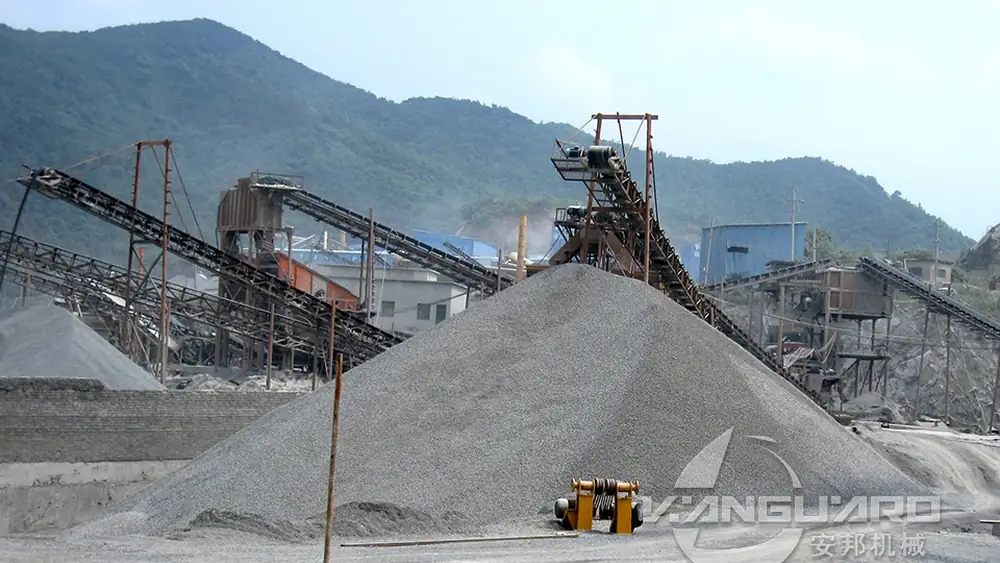
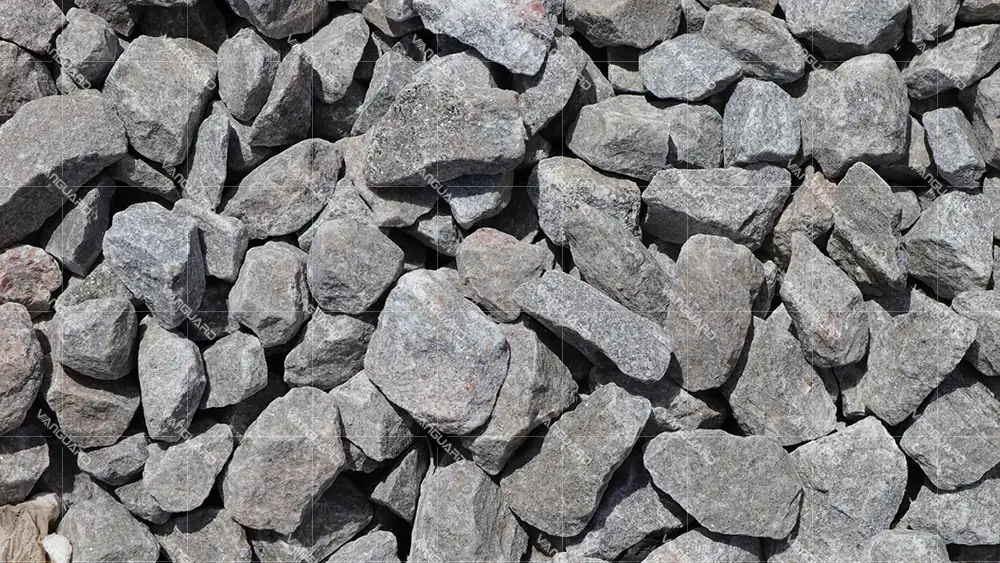
Limestone is a sedimentary rock made mostly of calcium carbonate (CaCO₃); a good deposit runs over 90% CaCO₃. A few numbers to keep handy:
- Mohs hardness 3–4, medium-hard and on the soft side; - compressive strength usually 50–120 MPa, dense types up to 150 MPa; - bulk density 2.6–2.7 t/m³, lighter than granite by a fair margin; - the big one: low abrasion. Low-silica limestone can show an abrasion index (Ai) around 0.02.
Low abrasion changes your whole selection logic. With granite you worry about wear parts; with limestone you worry about over-crushing and bridging — soft, sticky, powdery feed clogs the chamber instead of wearing it out. Run-of-mine with over 5% clay or over 3% moisture, pre-screen or wash it before the primary, don't dump it straight into the jaw.
2. The basic principles of crushing
Every crusher works through four force modes: compression, impact, shear, attrition. No machine uses just one, but one dominates.
- Compression: two plates or mantles squeeze the rock. Best energy use, best for coarse and hard feed. Jaw and cone crushers live here.- Impact: a fast rotor throws the rock against a breaker plate. Good cubic shape, controlled fines, great for medium-soft rock. Impact crushers live here.- Shear: toothed rolls or blades cut through. Rare in limestone lines, mostly shows up on clay seams.- Attrition: rock-on-rock and rock-on-liner scrubbing. You see it in the VSI "rock-on-rock" chamber, only matters in the fine stage.
Rule of thumb: coarse by squeezing, secondary by whatever your product needs, fine by impact plus scrubbing.
3. Primary stage: the jaw crusher
For limestone primary, the jaw crusher is the stage you can't skip. Run-of-mine from the blast comes in at 800–1000 mm and leaves at 150–300 mm for the secondary.
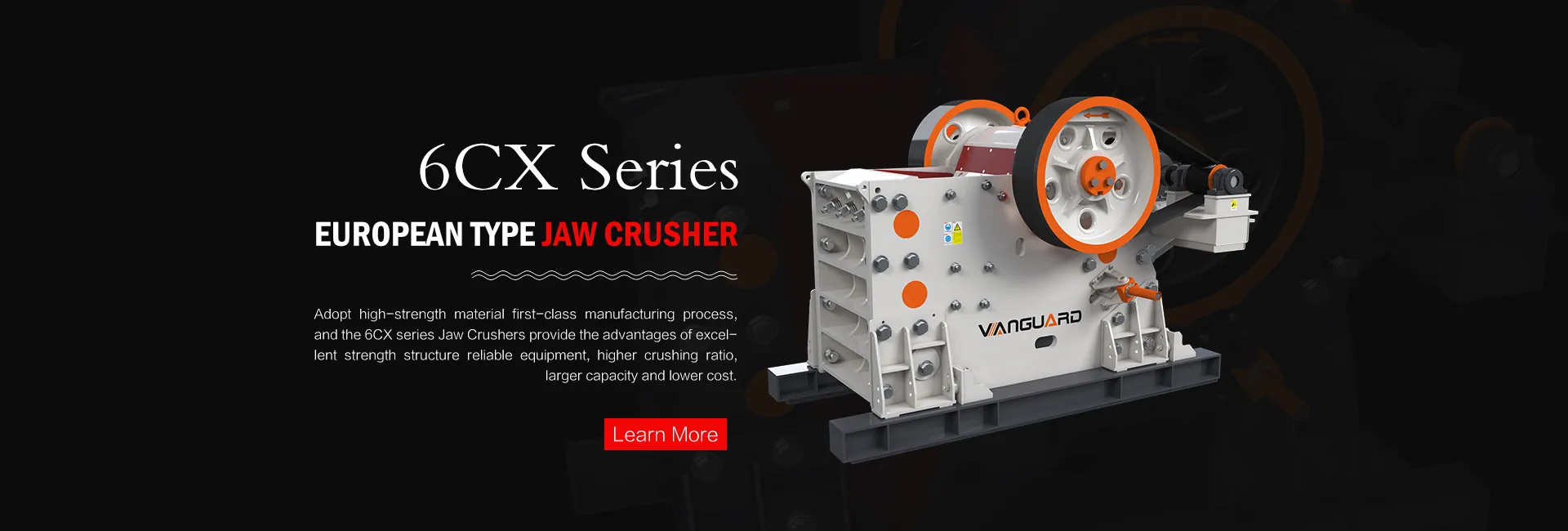
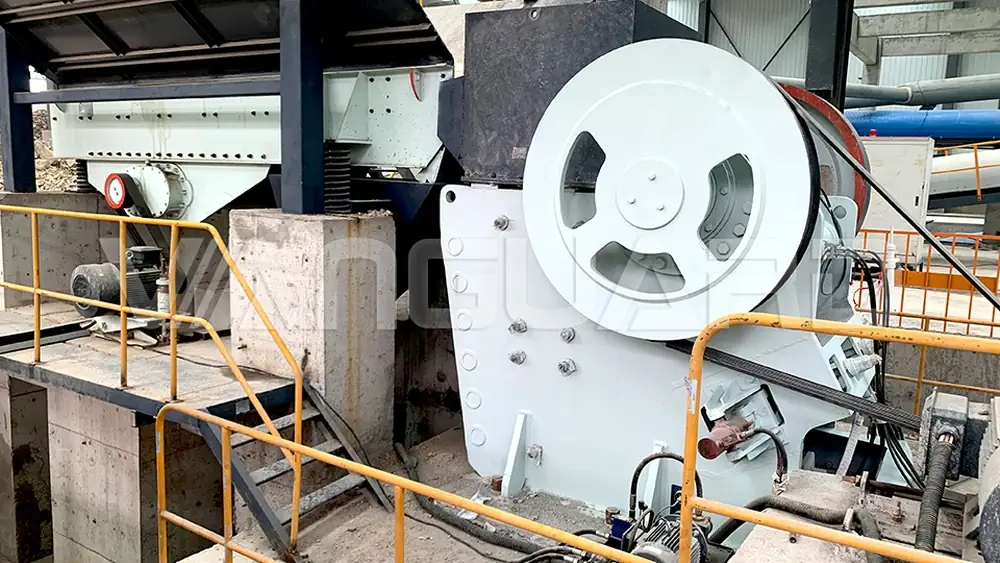
The 6CX series uses finite element analysis to optimize the crushing chamber and movable jaw motion trail and speed, delivering higher crushing efficiency at the same power. The mechanism is simple: the moving jaw swings on an eccentric shaft and forms a tapering chamber with the fixed jaw. Rock drops in at the top, the gap narrows going down, it gets squeezed smaller, and it falls out at the discharge setting.
Deep chamber or shallow? Limestone feeds big and soft, so a deep chamber (the 6CX European-style deep chamber, for instance) swallows feed steadily and rarely bridges. The closed-side setting (CSS) normally sits 150–250 mm — set it from the feed size your secondary wants. Close it too far and the primary becomes the bottleneck that strangles the whole line.
Vanguard Machinery's PE·PEX series and the 6CX European jaw both do this job: PE·PEX is simple, rugged, cheap spare parts; 6CX has the deeper chamber and lower specific energy. Get "eats big rock reliably" sorted at primary and everything downstream gets easier.
4. Secondary stage: cone vs impact
This is where limestone gets interesting — secondary works with either a cone or an impactor, both give saleable product, the difference is what you value.
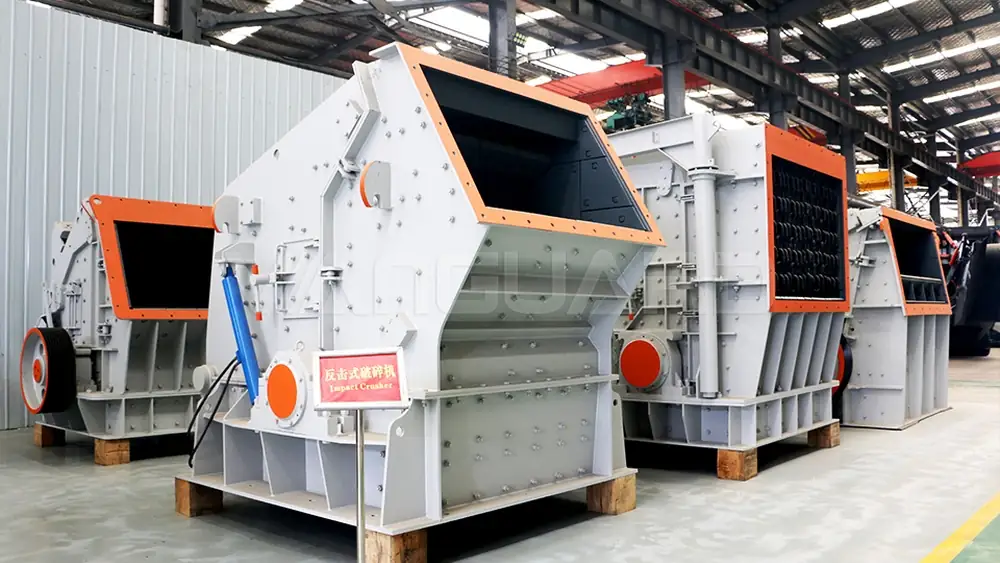
- Impact crusher (PF·PFV): PF/PFV impact crushers feature high-chromium blow bars, a big feed port and high crushing cavity. Blow bars fling rock at breaker plates, impact-dominated. On medium-soft low-abrasion limestone you get a very cubical product with few flats, and the open structure rarely blocks. Downside: some extra fines, and you swap blow bars as they wear.- Cone crusher (CS·CH single-cylinder, CSV Symons): inter-particle compression, rock crushed continuously in the chamber. Upside: long liner life, low running cost over time, steady gradation. Downside: on soft limestone the cubical shape from lamination isn't as sharp as impact, and if the chamber runs empty it vibrates.
What I tell customers: if the end product is concrete aggregate where shape matters, PF / PFV impact is the cheaper call on limestone. If you want big tonnage, fewer wear-part headaches, and you can live with slightly less perfect shape, a CS·CH single-cylinder cone is perfectly fine. Neither is wrong — it follows your product direction.
5. Tertiary / sand-making stage
If you need 5–10 mm, 3–5 mm fines, or manufactured sand (0–5 mm), the 30–40 mm off the secondary needs one more pass.
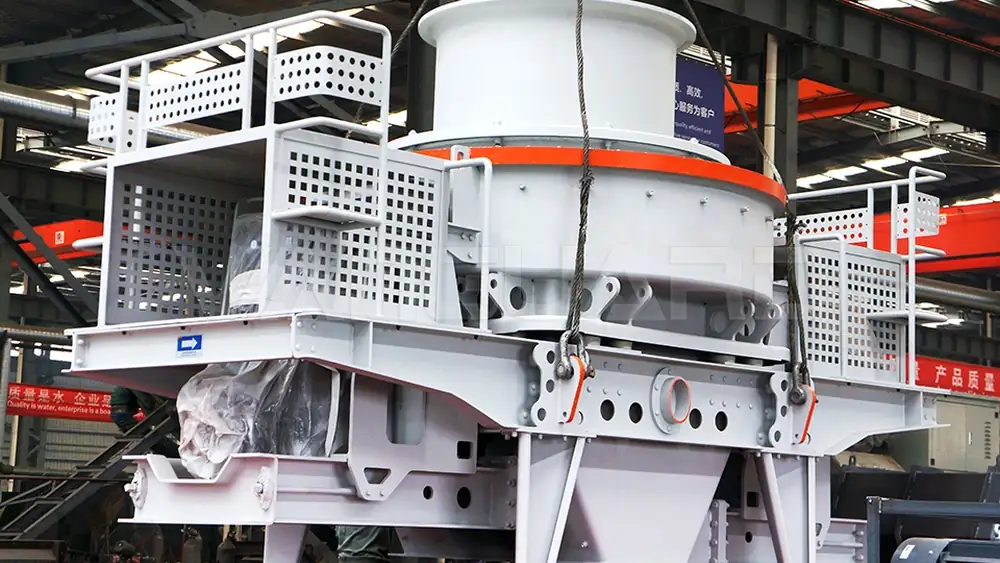
The vertical-shaft impact crusher, the 5X sand making machine, is the sand workhorse: feed enters central or cascade, gets flung by the rotor onto the surrounding liners, rock-on-rock or rock-on-anvil, knocking off edges and evening the gradation. Limestone sand has a trap — too-soft feed on rock-on-anvil over-crushes and the filler rate spikes, so for soft limestone run the "rock-on-rock" chamber and let a rock bed cushion it.
If you only need fines down to 10–20 mm and not sand, a fine crusher or a tightened cone CSS does it; you don't have to bring in a sand maker.
6. Screening and closed-circuit control
Crush and not screen, you've done nothing. The vibrating screen splits material by size: say >31.5 mm goes back, 10–31.5 mm is your aggregate, <10>
Closed circuit is the heart of the flow. Put a vibrating screen after secondary or tertiary, and the oversize above spec rides a belt back to the crusher for another pass — that's the "return". Running in a loop like this pins the top size of the final product inside the spec. If the contract says max 31.5 mm aggregate, the closed circuit catches the occasional oversize lump.
Field rule: return load normally runs 20%–40% of crusher throughput. Too low and you're leaving crushing ratio on the table; too high and the CSS is too tight or the chamber is blocking — adjust.
7. Typical 3-stage / 4-stage crushing flowsheet
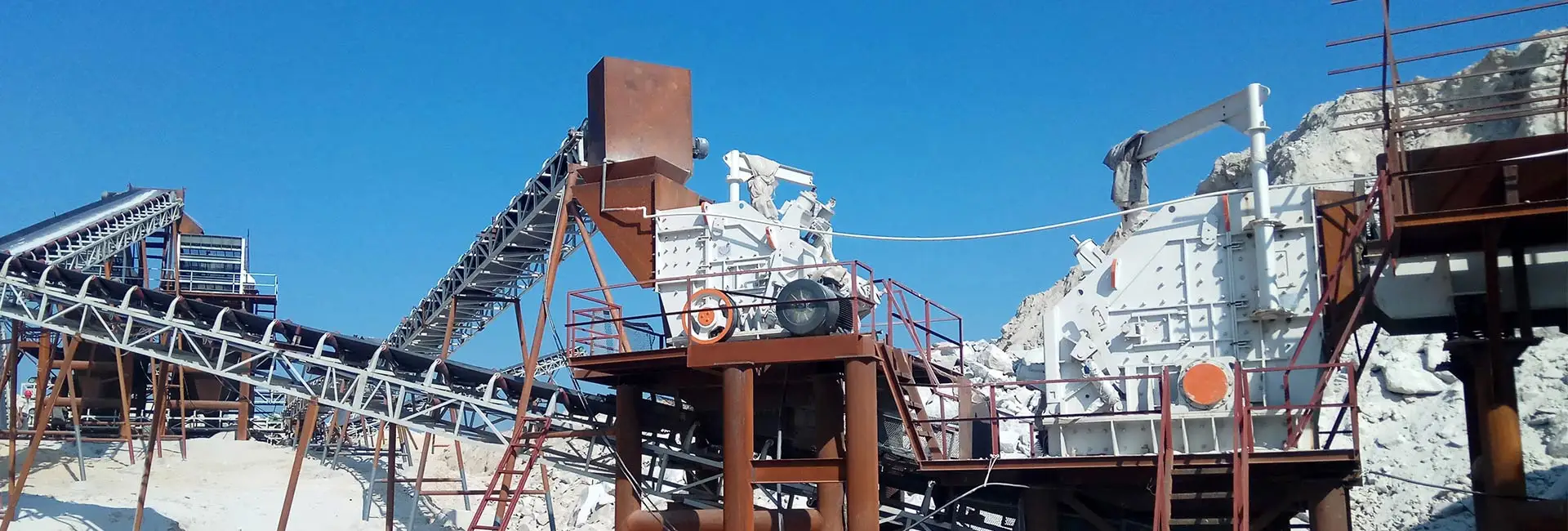
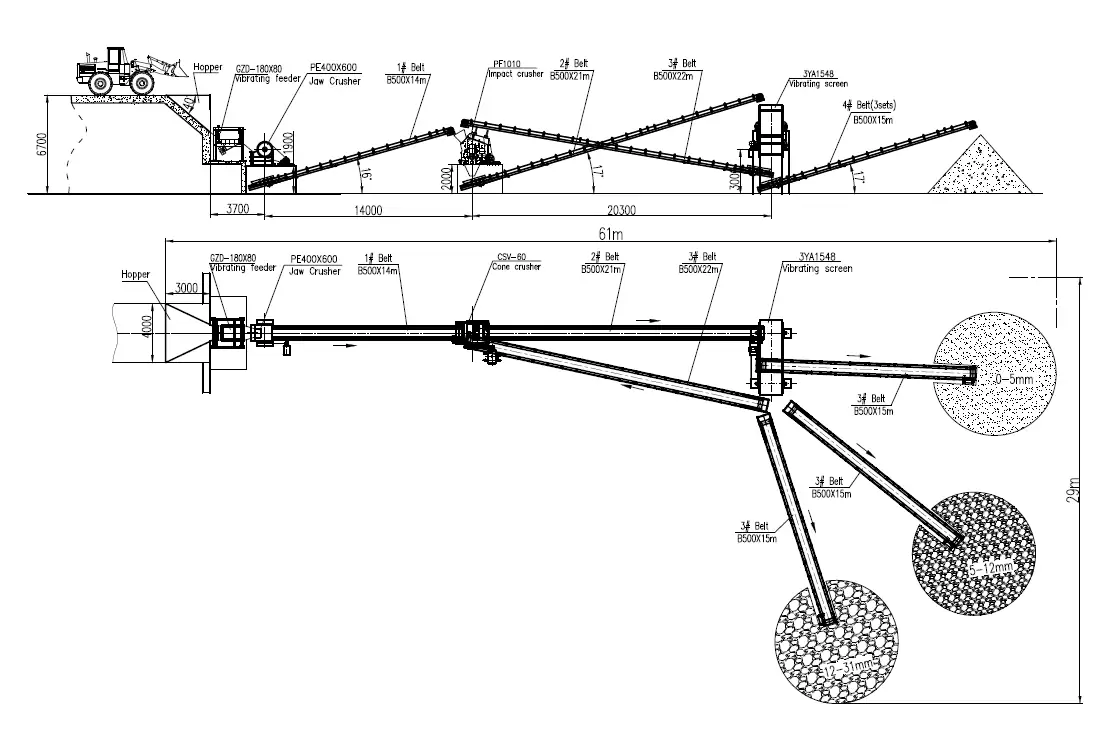
The common limestone aggregate line is three stages: primary → secondary → screen (closed circuit). Add a sand stage and it becomes four.
The table below is a 500 t/h limestone line I'd call typical: 800 mm feed, 0–31.5 mm graded product.
| Stage | Equipment | Feed size (mm) | Product size (mm) | Function |
| Feed | ZSW feeder | 0–800 | 0–800 | steady feed, pre-screen out clay |
| Primary | 6CX / PE jaw crusher | ≤800 | 150–250 | break big rock |
| Secondary | PF / PFV impact crusher | 150–250 | 30–50 | second break, shaping |
| Screen | vibrating screen | 30–50 | graded 0–5 / 5–10 / 10–20 / 20–31.5 | sizing + closed-circuit return |
| Fine/Sand | 5X sand making machine | 30–40 | 0–5 | manufactured sand (4-stage only) |
The three-stage line just drops the last row. The ZSW feeder shakes off a layer of mud and fines before primary, taking load off everything behind it.
8. Key parameter control
- CSS: primary 150–250 mm; secondary impact set by breaker-plate gap (equivalent CSS 20–50 mm); cone by hydraulics (13–45 mm). Measure before you set, don't guess. - Speed: jaw eccentric shaft 250–330 rpm — faster actually drops output because rock can't fall in time; VSI rotor tip speed 60–75 m/s is the common sand-making band. - Feed rate: keep the chamber full but not overflowing. Jaw cavity empty over 20% and liner wear goes uneven; impact fed too hard and the blow bars choke. - Circulating load: closed-circuit return 20%–40% is the normal band, held by screen aperture and CSS together.
These aren't fixed laws — take your own rock, run a trial, sample and sieve, then dial back.
9. Energy and wear analysis
Limestone crushing energy is low: a whole line runs about 1.5–3.0 kWh/t (add sand making and it reaches ~3.5). Primary takes the smallest slice, fine/sand the biggest — that's the pattern.
On wear parts, limestone is gentle on jaws, blow bars and cone liners, but two traps: a high-silica seam suddenly accelerates wear, and uneven feed burns one side of the liner first. My habit: flip wear parts at the midpoint, rotate blow bars four-position, don't wait for them to punch through — the downtime costs more than the part.
10. Common questions and FAQ
Mostly 3–4. But same name, a siliceous nodule layer can hit 5. Sample and load-test before selecting, don't trust the label.
800 mm feed, secondary wants 150–250 mm in, start CSS at 180–220 mm and tighten once you see the secondary coping.
Aggregate (shape) → PF/PFV impact. Big tonnage, fewer part swaps → CS·CH cone. Both work on limestone, follows your product.
20%–40%. Under 20% wastes capacity, over 40% means tight CSS or blockage.
Yes, but soft feed on the 5X runs "rock-on-rock", not rock-on-anvil, or you'll make too much powder.
Pre-screen with ZSW or wash it. Over 5% clay, keep it out of primary or the screen blinding and product dirt fail spec.
Over 3% moisture sticks in the chamber. Drying the feed isn't realistic; open the CSS, lower feed moisture, or pre-dewater on the feeder.
Limestone is naturally low-flat. If it's high, CSS is too tight or the circuit isn't closed. Open CSS, keep the return loop running.
Primary rated feed × 0.8 utilization, then a closed-circuit correction. Don't use nameplate full load — field always discounts it.
Low-abrasion limestone: jaw dies 2000–4000 h, impact blow bars 800–1500 h, cone liners 3000–6000 h. High silica halves all of it.
Primary and screen are the dust points. Enclosures plus baghouse — limestone dust collects easily, cheap investment, but environmental compliance is non-negotiable.
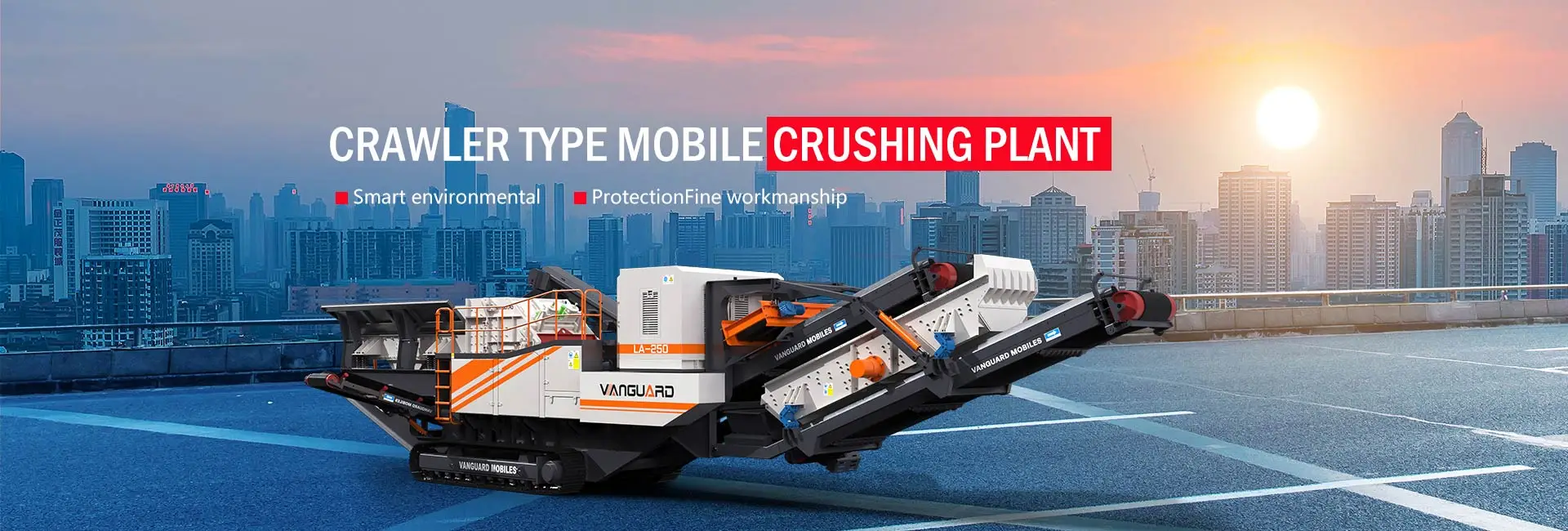
Under 500 kt/yr and scattered face, mobile saves civil works. Large scale, stationary wins on unit cost. Most limestone quarries run stationary.
Conclusion
Limestone crushing looks easy, but holding energy, shape and wear life all on spec still means tuning stage by stage. Know your rock, pick a steady jaw at primary, choose impact or cone at secondary by product direction, use the VSI for fines and sand, and lock the top size with a vibrating-screen closed circuit. Get the flow right and the operating half gets easy.
About Vanguard Machinery
Vanguard Machinery has ten-odd years on limestone lines end to end — ZSW feeders, 6CX/PE jaws, PF/PFV impacts, CS·CH cones, 5X sand makers, the whole chain in one place. If you've got a sample or a tonnage target, send the numbers and our engineers will pull a matching flow sheet and selection table for you.
Related Articles
• 6-Grade Granite Aggregate Production Line for Russian Asphalt Plants Put into Op(2026-07-22)
• Vanguard Machinery Showcases Mobile Crushing & Screening Plants at MINEENTRA 202(2026-07-22)
• Why Is My Jaw Crusher Wearing Out Too Fast? Causes...(2026-07-09)
• Why Mobile Crushing Plants Are Becoming Popular in...(2026-07-23)
• 200 t/h Limestone Crushing-and-Sand-Making Plant in Malaysia: Five-Size Mobile L(2026-07-22)
• Hydraulic vs Spring Cone Crusher: What Sets Them Apart and H...(2026-07-22)
• 300 TPH Mobile Crusher: Configuration, Capacity and Selectio...(2026-07-22)
• What Is a Crawler Type Mobile Plant? How It Works and How to...(2026-07-20)




