

Quick Answer
When a jaw crusher wears out too fast, the cause almost always comes down to four things: jaw-plate material that doesn't match the feed, bad feeding practice (non-choke feeding, segregation, oversize feed), an incorrect closed side setting (CSS) or stroke, and jaw plates that aren't flipped or rotated when they should be. Highly abrasive, high-quartz rock such as granite and basalt accelerates wear significantly. The fix is to match the manganese grade to abrasiveness (Mn13Cr2 / Mn18Cr2 or composite insert dies), maintain choke feeding, set the CSS correctly, rotate and flip the plates regularly, and pre-screen out clay and fines. Together these steps typically extend jaw-plate life by 30%-100%.
Key Takeaways
- ✔ The wrong jaw-plate material is the number-one cause of premature wear; highly abrasive rock needs Mn18Cr2 or composite insert dies - ✔ Choke feeding drives inter-particle crushing and even wear, and is the single most effective way to extend jaw-plate life - ✔ Oversize feed and one-sided segregation cause localized wear; keep feed size within 80%-85% of the feed opening - ✔ Rotating and flipping the plates spreads wear and uses the material fully, adding another 20%-40% of life - ✔ Pre-screening out clay and fines reduces abrasive wear and prevents packing
Warning Signs Your Jaw Crusher Is Wearing Too Fast
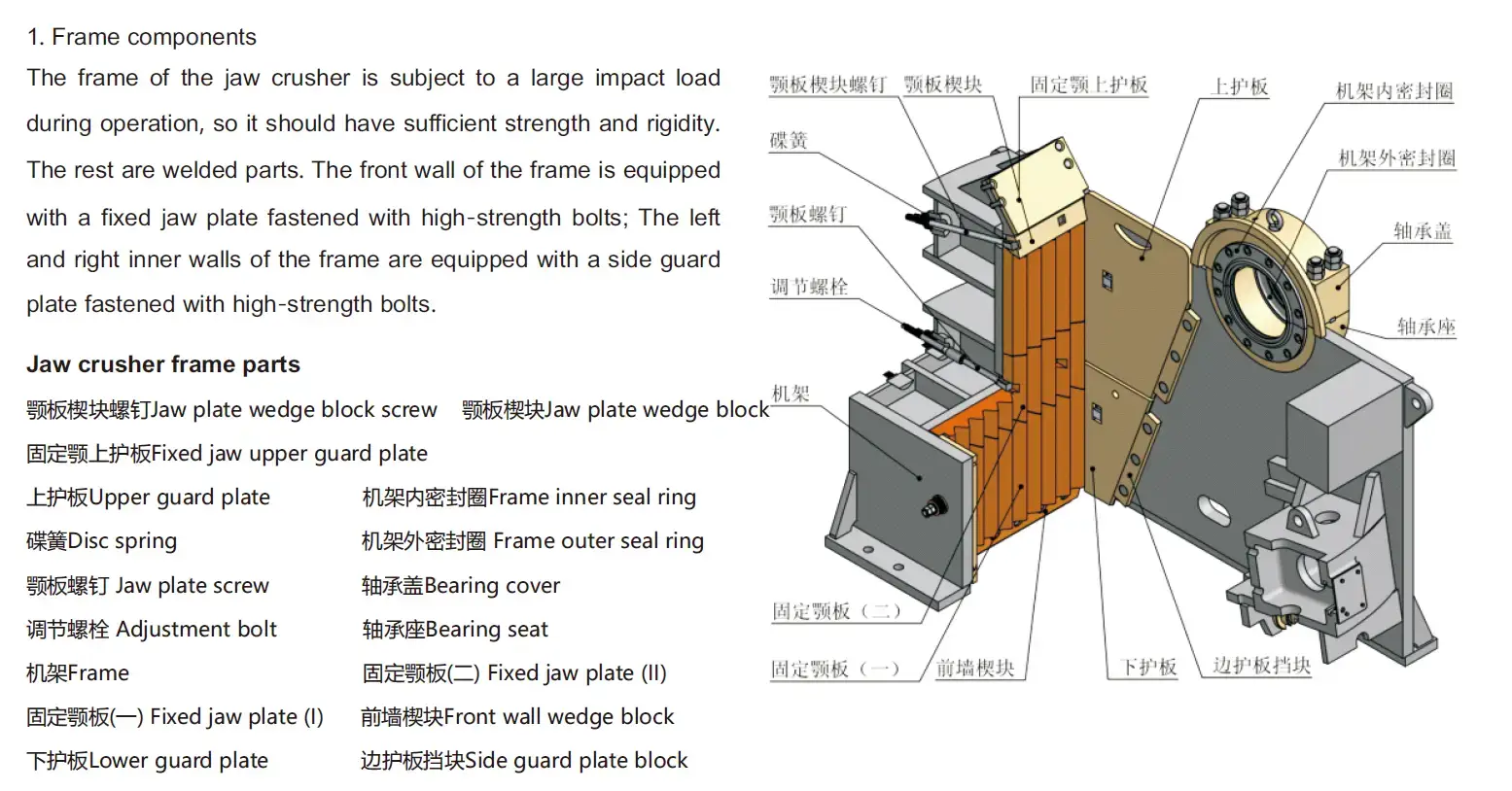
Jaw plates, cheek plates and the toggle plate are the main wear parts of a jaw crusher. The movable and fixed jaw dies take the most direct crushing force and wear fastest. Telling whether wear is too fast is not only about replacement frequency; you also need to factor in rock properties, throughput and the wear pattern.
A practical diagnostic sequence is: observe the wear pattern, identify the root cause (material, feeding, settings or maintenance), apply a targeted fix, then verify that life improves.
Common abnormal wear patterns include a hollow worn into the middle of the plate while the ends stay intact, pronounced wear on one side, teeth that flatten quickly, uniform rapid thinning, and localized spalling or cracking. Each pattern points to a different root cause and is the first clue for fast diagnosis.
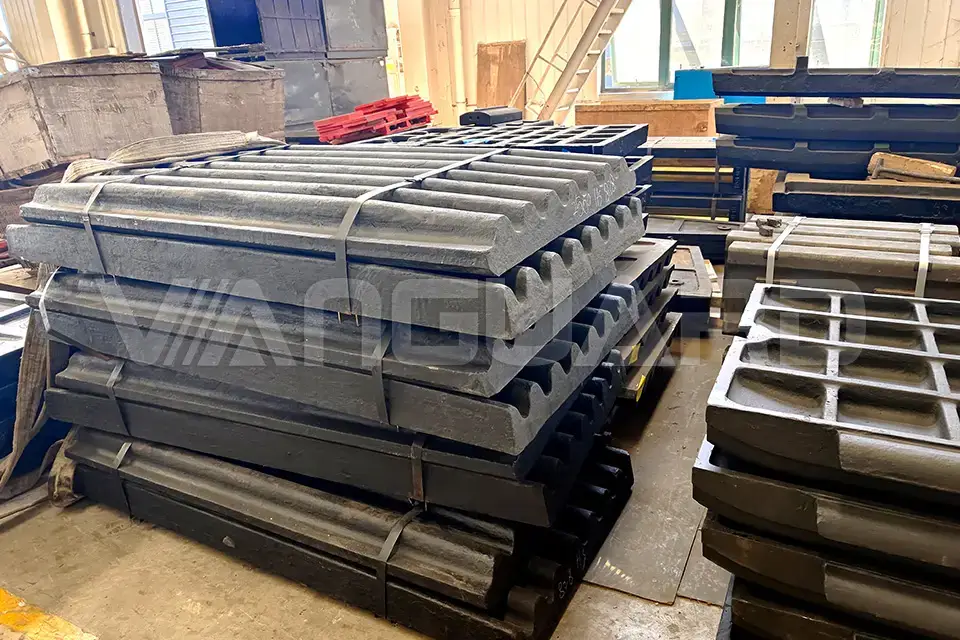
The table below gives reference life ranges for the main wear parts and the typical signals of premature wear, for on-site comparison.
| Wear part | Reference life | Signal of premature wear |
| Movable/fixed jaw die (medium-abrasion, e.g. limestone) | 6-12 months | Replacement needed in under 3 months |
| Movable/fixed jaw die (high-abrasion, e.g. granite) | 2-5 months | Replacement needed in under 1 month |
| Cheek plate | 8-15 months | Worn out 50%+ earlier than expected |
| Toggle plate | 12+ months (rarely a wear item) | Frequent breakage points to overload or tramp metal |
Six Root Causes of Premature Jaw-Plate Wear
Fast jaw-plate wear is rarely caused by a single factor; it usually comes from a combination of material, feed, operation and maintenance. The six causes below cover the vast majority of real-world cases.
Manganese steel relies on impact to work-harden and gain wear resistance. If the rock is highly abrasive but impact is low, the plate is worn away before it hardens, so life is short. Medium-abrasion rock is fine with Mn13, while highly abrasive granite or basalt calls for Mn18Cr2 or composite insert dies.
The higher the quartz content, the more abrasive the rock. Granite, at Mohs 6-7 with high quartz, wears jaw plates three to five times faster than limestone. Abrasiveness is inherent to the rock; you can only deal with it through better material and optimized settings.
Non-choke feeding concentrates impact on the middle of the plate and hollows it out. Segregation or one-sided feeding causes premature wear on one side, and oversize feed causes localized spalling and blockage. Feeding is the most overlooked yet most easily improved factor on site.
Too small a CSS raises the crushing work and the load on the jaw and speeds up wear; an incorrect stroke or eccentric throw disrupts material flow inside the chamber. Set the CSS according to the product spec and throughput target rather than chasing the finest possible output.
Jaw dies are usually symmetrical top-to-bottom, with wear concentrated at the bottom. If they aren't rotated when needed, the bottom wears through while the top still has material left, wasting it. Regular flipping and rotation noticeably improves material utilization and overall life.
Clay and fines in the feed act as a grinding medium in the chamber, intensifying abrasive wear, and high moisture causes packing and blockage. Adding a pre-screen ahead of the crusher, such as the grizzly section of a vibrating feeder, to remove clay and fines noticeably reduces wear.
| Wear symptom | Most likely cause | Quick fix |
| Hollow in the middle, ends intact | Long-term non-choke feeding | Switch to choke feeding |
| Pronounced one-sided wear | Segregation, one-sided feed | Feed centered and evenly |
| Whole plate thins rapidly | Material mismatched to abrasiveness | Upgrade to Mn18Cr2 / composite die |
| Teeth flatten quickly | High quartz content in feed | High-wear material + coarse-tooth die |
| Localized spalling or cracking | Oversize feed or tramp metal | Control feed size, remove metal/debris |
| Loose plates, broken bolts | Wedges/bolts not tightened | Check and re-tighten fasteners |
How to Choose the Right Jaw-Plate Material
Material is the biggest factor in how long plates last. The basic idea is to match the wear mechanism of the material to the impact and abrasion conditions of the feed.
| Grade | Characteristics | Suitable feed |
| Mn13 (ZGMn13) | Tough; needs high impact to work-harden | Low-to-medium hardness, medium abrasion (limestone) |
| Mn13Cr2 | Chromium raises initial hardness and wear resistance | Medium-to-high hardness, medium abrasion |
| Mn18 | Higher manganese, stronger work-hardening | High impact, large jaw crushers |
| Mn18Cr2 | High manganese and chromium, best wear resistance | High hardness, high abrasion (granite, basalt) |
| Composite / insert (TiC / alloy) dies | Localized ultra-high wear resistance | Extreme abrasion, low-impact duty |
For medium-abrasion rock (limestone, dolomite) choose Mn13 or Mn13Cr2 to balance toughness and cost; for high-abrasion rock (granite, basalt, river gravel) choose Mn18Cr2; where impact is too low to trigger work-hardening, composite insert or alloy dies actually last longer. A material analysis is more reliable than a rule of thumb. Need help selecting wear parts? Get a free material analysis from Vanguard Machinery.
Choke Feeding: The Key to Longer Jaw-Plate Life
Choke feeding is the most effective and lowest-cost way to extend jaw-plate life, yet it is often overlooked on site.
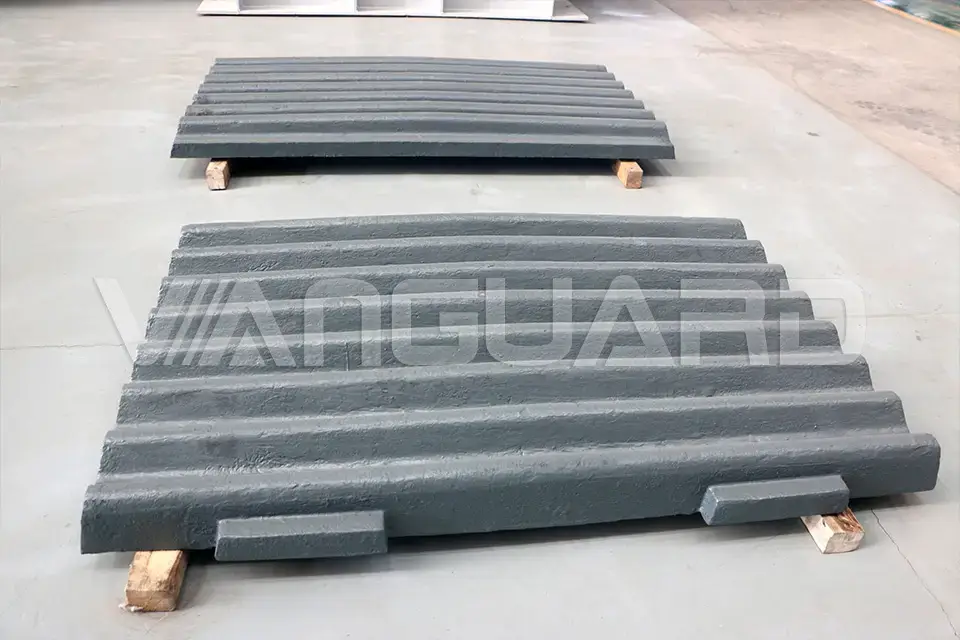
Choke feeding keeps the crushing chamber consistently full of material so that particles crush against each other (inter-particle crushing) rather than relying on jaw impact alone. Crushing force is then distributed more evenly, and so is jaw-plate wear.
| Item | Choke feeding | Non-choke feeding |
| Crushing mode | Mainly inter-particle | Mainly single-particle impact |
| Jaw-plate wear | Even, slower | Concentrated in the middle, faster |
| Throughput | Stable, near rated | Fluctuating, lower |
| Particle shape | High cubicity | More flaky/elongated |
| Energy per ton | Lower | Higher |
Tooth Profile and CSS Optimization
Once material and feeding are set, the right tooth profile and CSS can further optimize wear and product quality.
Coarse-tooth plates concentrate crushing force, are best for primary crushing of large, hard rock and last longer; fine-tooth plates give more uniform product but wear out faster in medium-fine duty. For highly abrasive rock, favor coarse teeth to extend life.
Set the CSS to the product spec and avoid going too small, which causes overload wear; keep feed size within 80%-85% of the feed opening to avoid oversize jamming and localized spalling. Regularly check the eccentric shaft, toggle plate and tension-rod spring to keep the crushing action running right.
Daily Maintenance to Extend Jaw-Plate Life
Even with the right material and settings, a lack of routine maintenance will still send jaw plates to scrap too early.
When the lower part is clearly worn while the upper part still has material left, rotate the plates promptly to redistribute the wear zone and raise material utilization by 20%-40%. Symmetrical plates can also be flipped for a second life.
Use the grizzly section of the vibrating feeder to screen out clay and fines before they enter the chamber. This both reduces abrasive wear and prevents chamber blockage and packing, and is especially useful for wet, clay-rich feed.
Field Verification: Improving Jaw-Plate Life on Abrasive Rock
The diagnostic approach to jaw-plate wear needs to be proven in the field. Drawing on Vanguard Machinery's experience in crushing highly abrasive rock such as granite and basalt, three patterns stand out:
Material matching pays off the most. Upgrading the fixed and movable jaw dies from Mn13 to Mn18Cr2 typically extends the replacement interval for high-quartz feed from under one month to about three months, with a clear drop in wear-part cost per ton.
Choke feeding brings immediate improvement. Switching from non-choke to choke feeding eliminates the hollow in the middle of the plate, evens out wear, and can raise throughput per die set by roughly 20%-30%, with steadier output.
Pre-screening and flipping are low-cost multipliers. Adding a grizzly pre-screen ahead of clay-rich feed, and rotating the plates promptly once the lower section is worn, can extend overall jaw-plate life by a further 20%-40%.
Together these confirm that combining material matching, choke feeding and regular maintenance is the most reliable way to extend jaw-plate life on abrasive rock.
The Hidden Cost of Premature Wear
The cost of fast jaw-plate wear goes far beyond the price of a set of plates; it also includes lost throughput and labor from frequent shutdowns for replacement.
| Jaw-plate life | Tonnage per set (indicative) | Wear-part cost per ton | Notes |
| 1 month (too fast) | ~30,000 t | High | Frequent stops, high change-out labor |
| 3 months (improved) | ~90,000 t | Medium | Material upgrade + choke feeding |
| 5 months (optimized) | ~150,000 t | Low | Combined material, operation, maintenance |
(Figures are indicative for a typical mid-size jaw crusher and vary with throughput and feed.)
FAQ
With medium-abrasion rock such as limestone, movable/fixed jaw dies typically last 6-12 months; with high-abrasion rock such as granite it may be only 2-5 months. If life is clearly below this range, the material, feeding or maintenance is usually at fault and should be checked one by one.
This is the classic sign of long-term non-choke feeding. Material concentrates its impact on the middle of the chamber and hollows it out. Switching to choke feeding and keeping the chamber full redistributes wear evenly.
Not necessarily. Manganese steel work-hardens through impact; if impact is too low, simply raising hardness can make it brittle and prone to cracking. The key is matching the material to the feed's impact and abrasion; low-impact, high-abrasion duty actually suits composite insert or alloy dies better.
No, as long as feed size is reasonable and the CSS is set correctly. Choke feeding means keeping the chamber full, not overfeeding. With stable feeder control it actually makes throughput steadier and wear more even.
Generally within 80%-85% of the feed-opening width. Oversize material lodges at the chamber mouth and pounds repeatedly, causing localized spalling and blockage, and is a common cause of plate cracking.
There is no fixed interval; judge by the wear pattern. Rotate when the lower part is clearly worn while the upper part still has material. Checking the wear profile regularly and rotating when needed raises material utilization by 20%-40%.
Considerably. Clay and fines form a grinding medium in the chamber and intensify abrasive wear, while high moisture causes packing and blockage. Pre-screening out clay and fines before the crusher is the key to longer plate life with clay-rich feed.
For low-to-medium abrasion, Mn13 or Mn13Cr2 offers the best value; for high-abrasion rock such as granite and basalt, choose Mn18Cr2. Base the choice on a material analysis, especially quartz content, rather than experience alone.
Yes. Too small a CSS significantly increases crushing work and jaw load, speeds up wear and can overload the machine. Set it to the product spec; when a finer product is needed, achieve it with a downstream cone crusher or sand maker rather than forcing the jaw CSS smaller.
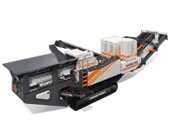
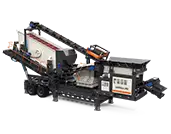
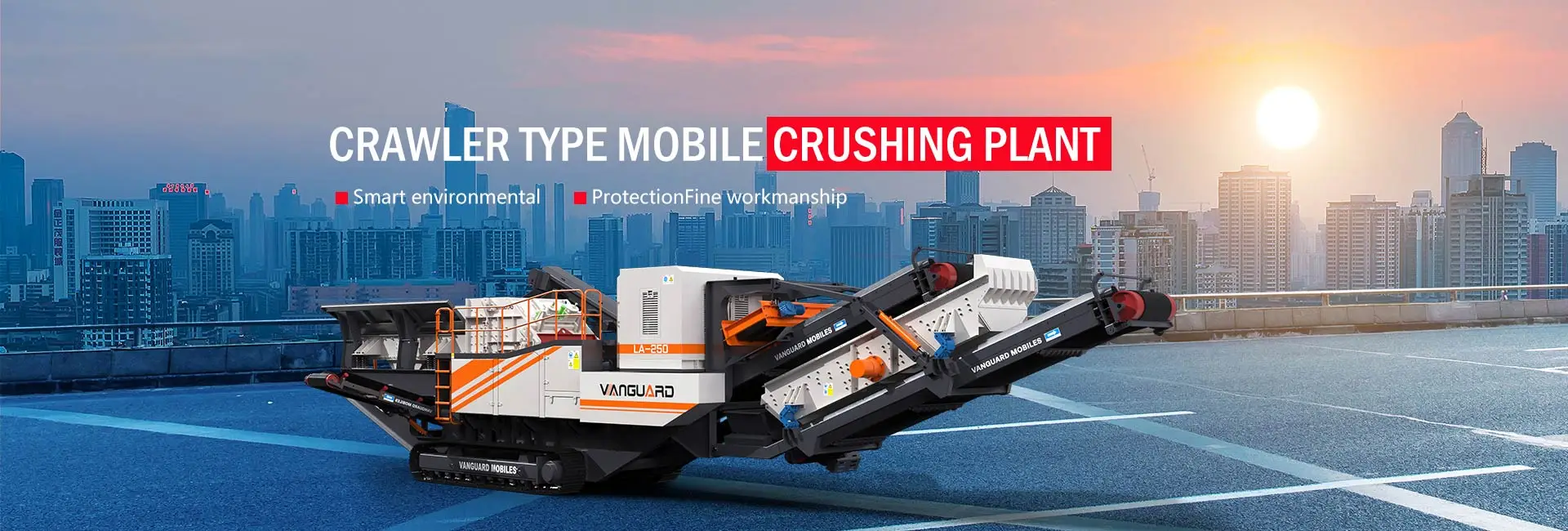
Under the same feed and operation, essentially yes. Mobile jaw plants (such as wheeled VPE Series or crawler C96/C106/C116 units) use the same core crusher as stationary units, so plate selection follows exactly the same logic and equally needs choke feeding and regular maintenance.
Conclusion
Premature jaw-crusher wear is a solvable, systematic problem. The core approach is to match the jaw-plate material to abrasiveness (Mn13Cr2 / Mn18Cr2 or composite inserts), maintain choke feeding for inter-particle crushing, set the CSS and feed size correctly, flip and rotate the plates regularly, and pre-screen out clay and fines. Together these steps typically extend jaw-plate life by 30%-100% and sharply cut wear-part cost per ton. If you are unsure of the root cause, start with a material analysis and a wear-pattern diagnosis, then treat the specific problem.




