



Key Takeaways
- A jaw crusher is not afraid of rock — it is afraid of dirt. Clay, topsoil and fines pack the crushing chamber, kill throughput, eat liner life, and cause bridging stoppages.- A vibrating grizzly feeder is the cheapest fix: it feeds evenly and lets undersize and clay drop through the bar gaps before the rock ever reaches the chamber.- A pre-screen (a dedicated vibrating screen ahead of the jaw crusher) scalps cleaner, produces a sellable fines fraction, and suits high-clay, wet or purity-sensitive operations.- Grizzly bars keep dirt out of the chamber; a pre-screen separates the fines cleanly. Dry feed with under ~20% fines: a grizzly is enough. Sticky, wet or high-clay feed: you need a pre-screen.- Look at the material first, then at where the fines should go, then at the site layout. Most indecision comes from not knowing your feed.
Why the Problem Usually Starts at the Feed End
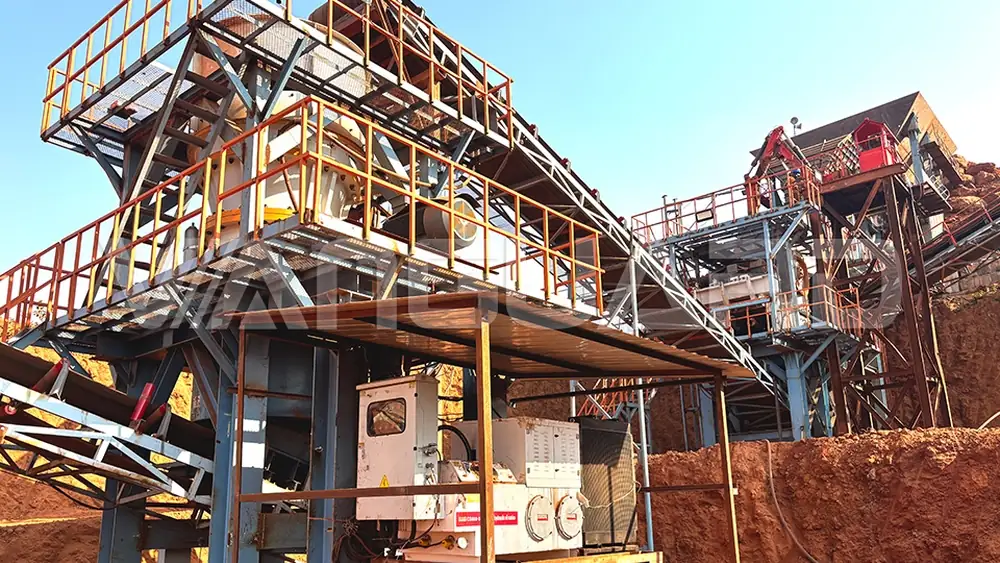
- A jaw crusher breaks rock in the compression chamber between the moving and fixed jaws, and the chamber works best when rock sits against rock and moves down in layers. Once clay and a lot of fines get mixed in, they pack the voids first; the rock floats on top, never settles, and throughput drops while power draw climbs. - Sticky wet feed also bridges at the chamber mouth: big lumps lock in place up top while mud clogs below. Operators poking the chamber with a bar is a daily routine on those sites, and the interrupted feeding punishes the liners and the toggle. - Pushing fines and dirt through the chamber means paying your crusher to do a screen's job: liner wear doubles, over-crushing increases, and the discharged material becomes harder to screen downstream. - So feed-end selection really answers one question: how much clay and fines must be intercepted before material enters the chamber? Get that right and everything after it falls into place.
The Vibrating Grizzly Feeder: Even Feeding and Scalping in One Unit
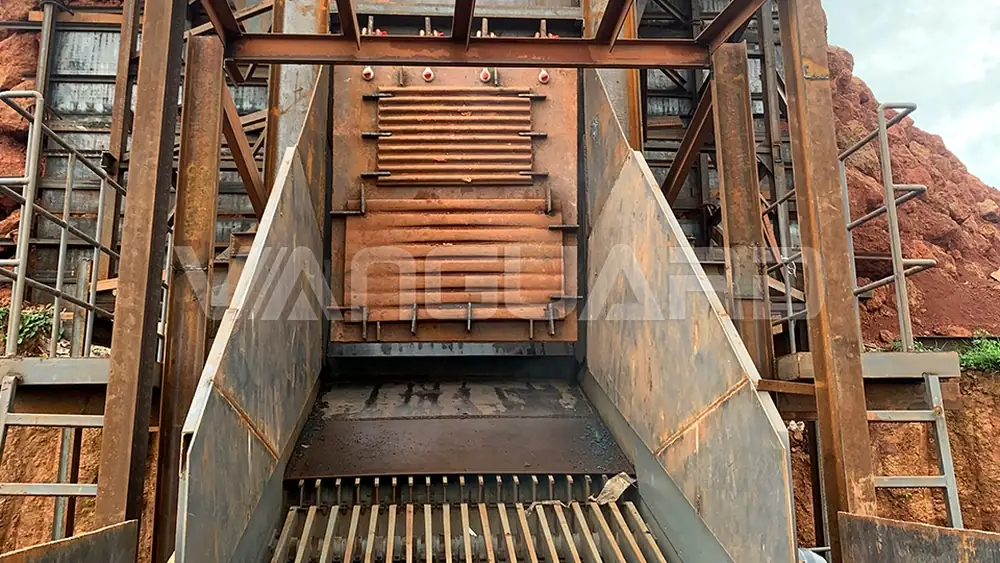
- A grizzly feeder is a vibrating feeder with grizzly bars: feed from the hopper lands on the trough, a vibrating drive moves it forward at a steady rate, and the trough bottom is a set of parallel bars with a gap between them. - Everything smaller than the gap — clay, sand, fines — drops through onto a bypass belt underneath and leaves the circuit; the lumps stay on top of the bars and travel into the jaw crusher. One machine does both even feeding and scalping. - It scalps coarse. Bar gaps typically run 40–100 mm, so all it really separates is "lumps" from "small plus dirt" — there is no precise sizing by fraction. But precisely because the structure is simple and there is no screen cloth to blind, it is the most reliable option when the feed is not too dirty. - On a primary line fitted with a grizzly feeder, the jaw crusher receives clean, even, chamber-filling feed. Liner life and capacity both hold steady — which is exactly why it became the default choice for primary feeding.
The Pre-Screen: Screen First, Crush What Needs Crushing
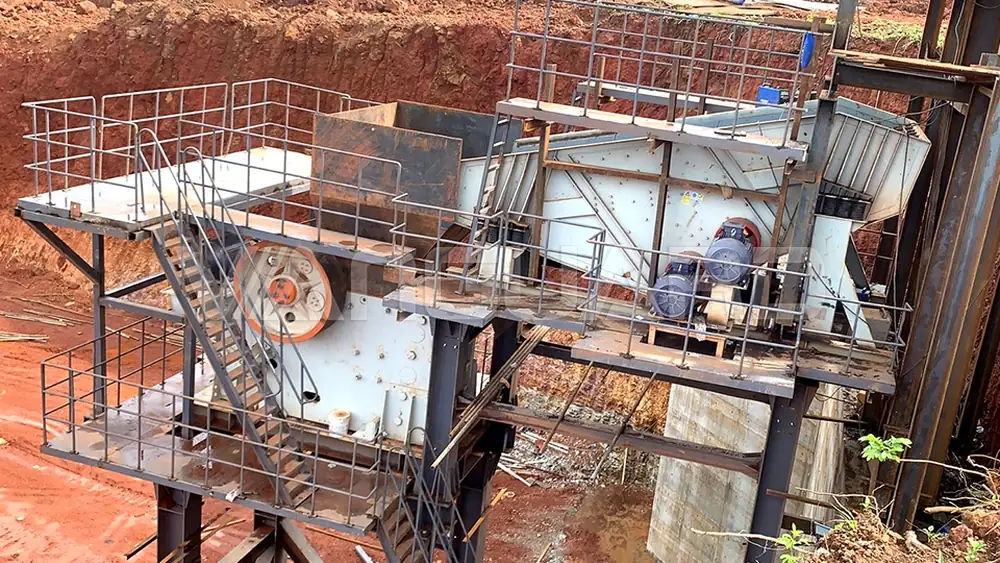
- A pre-screen places a dedicated vibrating screen (a circular-motion screen or a bar screen) ahead of the jaw crusher: hopper feed passes over the screen deck, undersize goes straight to a bypass belt, and oversize enters the crusher. - Compared with grizzly bars, a real screen deck opens its aperture precisely by fraction, and the undersize comes off clean — that material can be sold directly as product or routed to the next stage without passing through the chamber. - The price is money and space: one more screen, another drive group, a support steel structure and a bigger footprint. Screen cloth blinds and wears; in sticky wet duty you add self-cleaning media and keep spares on the shelf. - A pre-screen scalps clean and can make product, but on fairly clean dry feed it is overkill — the extra capital may never pay itself back.
The Two Routes Side by Side
| Item | Grizzly feeder | Dedicated pre-screen |
| Scalping quality | Coarse: lumps vs small-plus-dirt | Precise separation by fraction |
| Fines destination | Mixed into the bypass stream | Can be stockpiled or sold separately |
| Sticky wet feed | Bars blind when feed gets dirty | Self-cleaning media handles it better |
| Investment and footprint | Low: one unit does two jobs | High: screen + structure + bypass |
| Maintenance | Swap bars, nearly maintenance-free | Screen media is a wear part |
- In one line: the grizzly keeps dirt out of the chamber, the pre-screen separates fines so you can account for them.
When a Grizzly Feeder Alone Is Enough
- Clean feed: a thin overburden layer, clay content below roughly 20%, dirt arriving as scattered seams that drop straight through the gaps. - Dry material: low moisture, mud does not stick to the bars or cake in the chamber, no mud rolls forming on the bar deck. - Fines with no special destination: whatever falls through rides along in the bypass stream, and the next stage neither sells it nor suffers from it. - Thin-overburden benches in open pits and the first stage of dry-method aggregate lines get by with a single grizzly feeder in most cases. The money saved goes further in the jaw crusher and the downstream screening.
When a Pre-Screen Is a Must
- High clay content: above roughly 25% clay, bar gaps cannot pass it fast enough and they will blind sooner rather than later — you need screen media with self-cleaning arrangements.- Sticky wet feed: wet-season mining, washed material, riverbed gravel — once moisture rises the clay turns glue, and a screen with spray-bar connections is far easier to live with than bars.- Fines sold as product: when undersize must be stockpiled or sold separately and separated by fraction, grizzly bars simply cannot do it.- A fussy second stage: if your secondary is an impact crusher, which is sensitive to clay and moisture, a pre-screen stops being optional and becomes mandatory.- A mobile unit at primary: a mobile crushing plant already integrates feeding, pre-screening and crushing on one chassis, so the feed-end decision is made inside the machine. A fixed line has to answer this question itself — which is exactly the point of this article.
Setting the Bar Gap
- The gap follows two things: the jaw crusher's closed-side setting and the destination of the bypass material. To keep dirt out only, run 40–60 mm; to make the chamber crush only what truly needs crushing, set the gap near the CSS, 80–100 mm. - The wider the gap, the less enters the chamber and the more bypasses it — but bypass material has never been crushed, so its shape and grading differ from the crushed stream. Mixed together, that hurts downstream screening efficiency. Wider is not automatically better. - Deck angle and vibration force must match: too shallow and material crawls, throughput suffers; too steep and material skates over the bars before the clay has time to drop through. Amplitude and inclination are set at the factory for your duty and only fine-tuned on site.
| Bar gap | Mainly scalps off | Typical duty |
| 40–60 mm | Dirt, fines, scattered small material | Dirt control on fairly clean dry feed |
| 60–80 mm | Small lumps plus dirt, mid-fines recovered | Bypass reused or sold |
| 80–100 mm | Near the CSS; chamber crushes lumps only | High tonnage, relieving the jaw crusher |
Combined Layouts: Both Routes Together
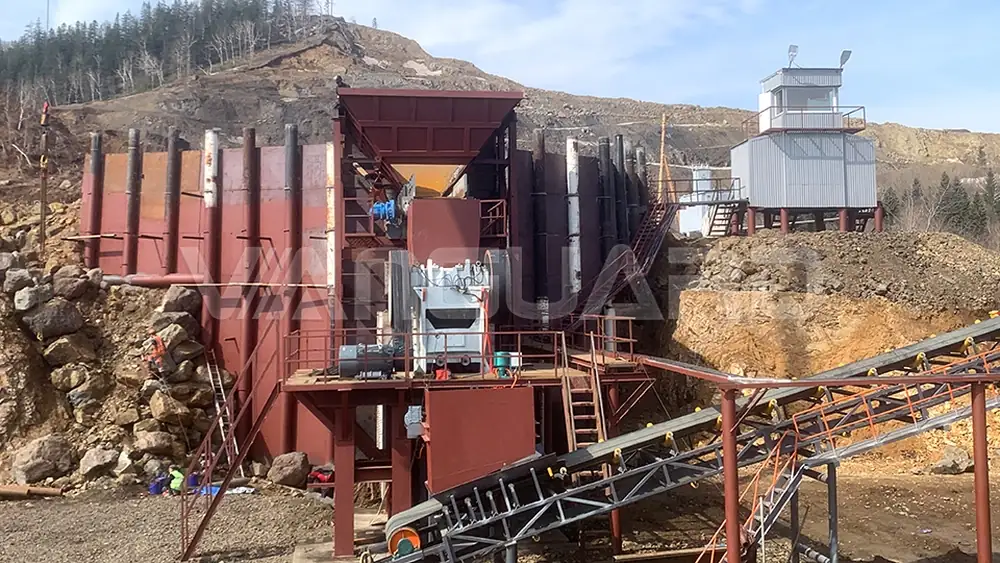
- The common arrangement is hopper + grizzly feeder + jaw crusher, with the bypass belt running underneath the bars; when the feed gets dirtier still, a dedicated screen goes in behind the feeder for a two-stage dirt barrier. - High-tonnage lines can jump straight to a double-deck screen: top-deck oversize to the jaw crusher, mid-deck material on its own route, and the bottom deck collecting the powder and dirt. More capital, but every stream stays clean. - Whatever the layout, the bypass belt width and speed must match the undersize tonnage, and the stockyard needs room for the dirt pile. Settle these details at the general-arrangement stage, not after the equipment arrives. A competent equipment supplier gives the bypass tonnage and its destination a dedicated page on the layout — precisely so this step is never forgotten.
A Short Checklist Before You Buy
- Get the feed data first: clay content, moisture, maximum lump size, grading curve — averaged over several shifts, not one glance. These four fields are mandatory on Vanguard Machinery's selection sheet because they decide the route outright. - Fix the bar gap and the destination of the bypass stream: whether the undersize is sold, stockpiled or blended back determines the gap size and where the bypass belt lands. - Check feeding capacity against the feed opening: the feeder trough should be one size narrower than the jaw crusher feed opening with clearance at both sides, so lumps never wedge on the edges. Vanguard Machinery flags this item in red on every layout for a second review. - Verify motor power and mounting angle against the feed: sticky wet duty calls for higher amplitude or a variable-frequency drive, with the inclination adjusted to match. Vanguard Machinery’s variable-frequency feeder models are a common fit for exactly this duty. - Leave room for maintenance: grizzly bars should withdraw as complete rows, screen media should slide out sideways, and access platforms plus lifting points belong on the foundation drawing from day one. Vanguard Machinery's bars use a segmented quick-change design — one row swaps out in about half an hour.
FAQ
Between 40 and 100 mm, following the crusher setting and the bypass destination. For dirt control only, 40–60 mm; to lighten the chamber's load, set it near the closed-side setting.
Most lines manage with a grizzly feeder alone. Add a pre-screen when clay exceeds about 25%, the feed is badly sticky and wet, or the fines must become a product.
Occasionally, and that is normal. Trapezoidal bars (wider at the top) plus the vibration force clear most bridging by themselves; a poke with a bar handles the rest.
Around 5 degrees as standard, a bit more for sticky wet feed. Angle and amplitude work as a pair — they are set at the factory for your duty, with only fine-tuning on site.
Switch to bar-type grizzly sections, raise the amplitude, and if needed fit heated bars or polymer liners. If it still cakes, that is the signal to move to a screen.
On a small line with clean feed you can get away with it, but you lose the even feed: the crusher runs off-center, capacity drops and liners wear unevenly. Not recommended.
For oversize lumps and heavy impact — a primary taking straight blasted rock, for example. Apron feeders take the beating; on ordinary aggregate duty a vibrating feeder is far more economical. Vanguard Machinery builds both; choose by lump size and impact.
This article is about screening before the crusher. Screening after the jaw is closed-circuit sizing for the final product — a different job entirely.
Bypass material has never been crushed, so its shape is naturally rough. Either narrow the gap to pass less, or route the fines through a shaping stage, depending on your product spec.
A grizzly feeder plus a dedicated screen, two dirt barriers in series, with self-cleaning screen media. That is Vanguard Machinery's standing recommendation for wet-season duty.
No. Feeding, pre-screening and crushing are already integrated on one chassis. When selecting the unit, just confirm the bar gap and screening configuration cover your feed.
Yes. Grizzly bars are made to spacing, so changing bars changes the gap; a screen needs new media. Vanguard Machinery uses segmented quick-change bars — plan the adjustment space early and you are set.
It follows the trough width and capacity: primary lines typically run from a few to a dozen or so kilowatts, and a variable-frequency model adjusts to the feed and saves power besides.
Depends on the feed. Against hard rock like granite, several months to a year; a hardfaced bar surface clearly extends life, and flipping the bars buys another stretch of service.
Yes — the most common phased approach. Reserve the screen foundation and bypass tie-ins at the general-arrangement stage, and adding the screen later needs no major rework. Most phased expansions Vanguard Machinery supports follow exactly this path.
Conclusion
Whether to add a vibrating grizzly feeder or a pre-screen ahead of your jaw crusher is not answered in an equipment manual — it is answered in your own feed. Under about 20% clay and reasonably dry, a grizzly feeder drops the dirt through and the job is done; heavy clay, high moisture, or fines that must become product — spend the money on a pre-screen. Read the material first, decide where the fines go, then look at the layout, and the choice stops being a dilemma. If in doubt, send your feed data to Vanguard Machinery and let an engineer run the numbers first. Get one step right at the feed end, and your jaw crusher's liners, capacity and power bill will all thank you for it.
Related Articles
• Why Is My Jaw Crusher Wearing Out Too Fast? Causes...(2026-07-09)
• How to Choose a Mobile Crushing Plant Manufacturer...(2026-08-27)
• How to Maintain a Crawler Type Mobile Jaw Crushing Plant(2026-08-05)
• Why Mobile Crushing Plants Are Becoming Popular in...(2026-07-23)
• Vanguard Machinery Brings Its Gold-Ore Processing Line to the 140th Canton FairG(2026-08-06)
• From Zhengzhou to Almaty: Vanguard Machinery to Exhibit at the 31st Kazakhstan K(2026-08-06)
• Vanguard Machinery to Exhibit at Construction Indonesia 2026, Deepening Its Sout(2026-08-06)
• Best PFV1315 Impact Crusher for Limestone Crushing in Saudi ...(2026-08-06)




