

Key Takeaways
Do not start a manufactured sand line by writing down machines. Start with the sand you intend to sell, and the equipment list writes itself.
- Product first: fineness modulus 2.3-3.0 (medium sand) is the common target, grading sits in zone II, stone powder is capped by the MB value- Rock sets the front end: granite, basalt and river pebble run a jaw plus a cone; limestone can take an impact crusher in the secondary stage- Four stages only: feed, primary, secondary, sand making plus screening; wet lines add a washer and fine-sand recovery- The sand maker is the star: a 5X vertical shaft impact crusher makes and shapes the sand, every stage before it just prepares feed- Dry or wet: no water or saleable powder points to dry; heavy clay or strict cleanliness points to wet
Get those five right and the rest is filling in machine counts by capacity.
Set the Product Spec Before You Buy Anything
Manufactured sand is not crushed fines. It is a product that gets checked against a standard - GB/T 14684 in China, ASTM C33 or a local spec elsewhere - and four numbers come up every time.
- Fineness modulus: 2.3-3.0 for medium sand, 3.1-3.7 for coarse, 1.6-2.2 for fine; ready-mix concrete usually wants medium - Grading: cumulative residue on the 0.15, 0.3, 0.6, 1.18, 2.36 and 4.75 mm sieves has to fall inside the zone, and zone II is the one most specs call for - Stone powder: when the MB value is at or below 1.4, powder can run up to about 10%; above 1.4 it usually gets squeezed to under 5% - Crushing value: class I at or under 20%, class II 25%, class III 30%; hard parent rock normally passes without argument
These four are not for memorising, they are for working backwards. If the fineness modulus will not come up, the sand maker is probably yielding poorly or the whole grading is sitting coarse. If powder is over limit, tune the classifier on a dry line or add washing on a wet one. If clay is over limit, wash the feed - no amount of downstream tuning fixes dirty rock.
The Parent Rock Sets the Front End: Hard and Soft Are Two Different Lines
Different rock, different front end, and getting this wrong is the one mistake nothing downstream can repair.
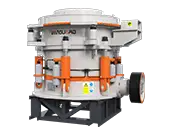
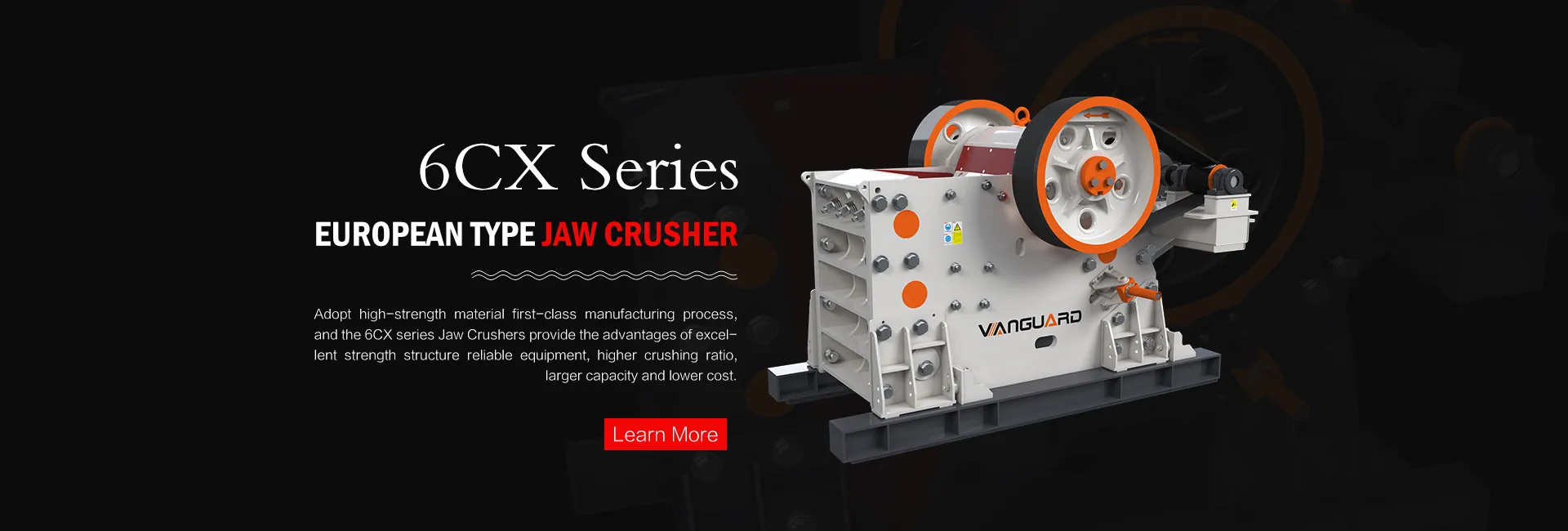
- Hard rock (granite, basalt, river pebble, Mohs 6-8): primary on a 6CX jaw crusher, secondary on a CP multi-cylinder hydraulic cone crusher. Compression crushing keeps shape and flakiness under control- Soft rock (limestone, dolomite, Mohs 3-4): the secondary stage can take a CI6X impact crusher, which forms the product in one pass, passes a lot of tonnage, and drops some sand along the way- Do not put an impact crusher on river pebble: at Mohs 7-8 with high silica, blow bars and liners go far too fast, and a cone spends the same money far better
Vanguard Machinery builds hard-rock sand lines around the 6CX plus CP pair with sand making and screening behind it; only soft-rock lines swap the secondary for a CI6X. The discharge size of that front end decides whether the sand maker ever runs full, so it is where money is easiest to save and easiest to save wrongly.
The Four-Stage Skeleton
Every manufactured sand line, at any tonnage, runs the same skeleton. Bigger capacity means more machines and larger sizes per stage, not more stages.
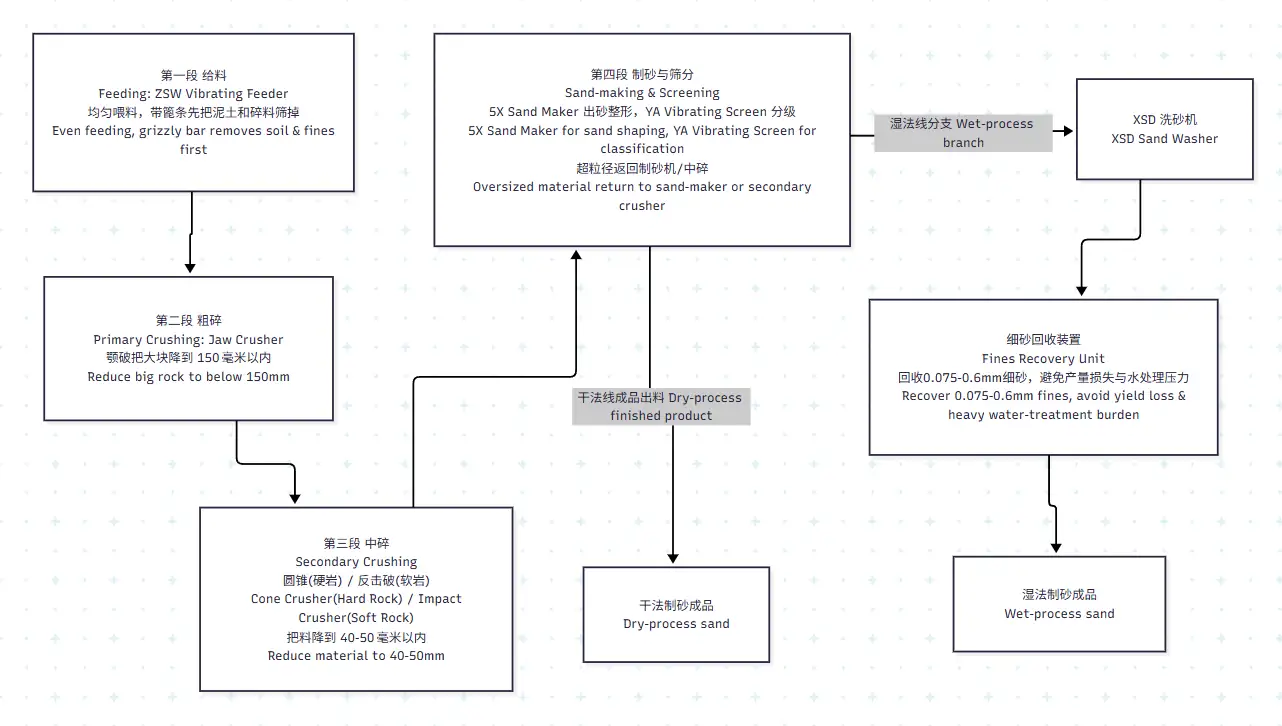
- Stage 1, feed: a ZSW vibrating feeder feeds evenly and its grizzly section drops clay and fines before they ever reach a crusher- Stage 2, primary: the jaw brings big rock down under 150 mm- Stage 3, secondary: a cone (hard rock) or an impact crusher (soft rock) brings it under 40-50 mm- Stage 4, make and screen: the 5X makes and shapes, a YA vibrating screen classifies, and oversize goes back to the sand maker or to the secondary
Wet lines hang an XSD sand washer after screening, then pull the fines back out of the water with a fine-sand recovery unit. Skip that and the whole 0.075-0.6 mm band walks off with the water - lost tonnage plus a water treatment problem you did not need.
Match the Configuration to the Tonnage
| Capacity | Feed | Primary | Secondary | Sand making | Screening | Wet add-ons |
| 50 t/h | ZSW small | 6CX small | can skip, single stage | one 5X | single or double deck | XSD optional |
| 100 t/h | ZSW medium | 6CX medium | one CP | one 5X | double deck | one XSD |
| 200 t/h | ZSW large | 6CX large | one CP (hard rock) | one 5X | triple deck | XSD plus fine-sand recovery |
| 300 t/h | ZSW large | 6CX large | two CP | two 5X | triple deck | XSD plus fine-sand recovery |
Treat that table as a skeleton, not a verdict. Whether a 50 t/h line can drop the secondary depends on your top size: if the run-of-quarry is already under 40-50 mm, feeding the 5X directly is perfectly fine; if you are digging out 700 mm boulders, the secondary stays.
Picking the Sand Maker: What 5X and VSI Each Do
The sand maker is the only machine on this line that actually makes sand. Everything upstream exists to feed it.
- 5X vertical shaft impact crusher: deep-cavity rotor, high throughput, better sand yield and particle shape - the first choice on hard rock and on larger lines- VSI vertical shaft impact crusher: mature design, lower investment, enough for small and mid tonnage where shape demands are not extreme- Rock-on-rock or rock-on-iron: rock-on-rock gives rounder grains and saves wear parts; rock-on-iron yields more sand and wears a little faster, so pick shape or pick tonnage
Feed into the sand maker generally stays under 40-50 mm. Too coarse and the machine cannot swallow it, so capacity and yield fall together; too fine and you have paid for a secondary stage you are not using. Vanguard Machinery sets the rotor type from rock hardness first, then sizes the machine from the sand yield you need.
Controlling Powder and Grading
Stone powder is where manufactured sand departs furthest from natural sand, and it is the one variable that can undo everything upstream.
- Dry lines: a classifier pulls off the excess powder, and that powder can be bagged and sold - no water anywhere, which is why dry wins in the north and in water-short regions - Wet lines: the washer does the cleaning, giving low-clay sand, but everything below 0.075 mm follows the water, so fine-sand recovery is mandatory - Grading tuning: if the fineness modulus runs coarse, raise rotor speed or increase circulating load; if it runs fine, drop speed and cut the return - Do not undersize the screens: screening is the throat of the line, so size screen area at 1.2 times the sand maker's peak throughput and err larger
When Vanguard Machinery fits a classifier to a dry line, the extraction rate is back-calculated from your MB value rather than picked off a shelf. On most sites where grading will not settle, the cause turns out to be an undersized screen or a classifier whose extraction was never dialled in.
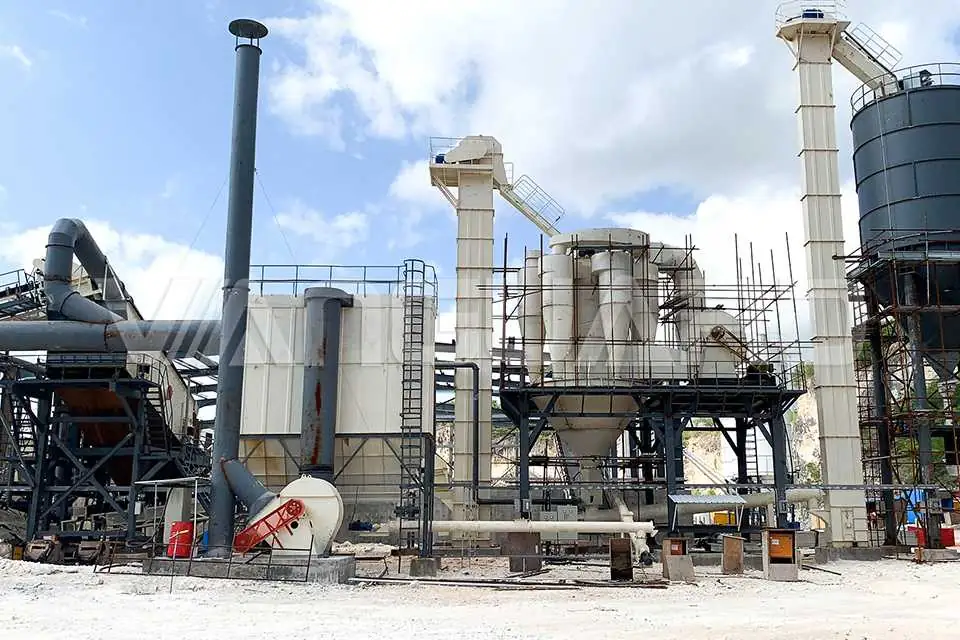
Three Questions to Pick the Right Configuration
You do not need a spec sheet memorised. Answer three questions and the equipment list falls out.
- Question 1, what is the sand for: ready-mix medium sand, dry-mix mortar, or an asphalt surface course? The end use locks the fineness modulus and the powder ceiling - Question 2, what is the parent rock: hard rock runs jaw plus cone, soft rock can take an impact crusher, high clay means washing up front - Question 3, dry or wet: short of water, or powder you can sell, means dry; heavy clay or strict cleanliness means wet
With those three answered, the front end, the sand maker, the screens and whether you wash are all settled. Vanguard Machinery field engineers ask the same three before drawing anything, because it is a lot harder to get the configuration wrong than it is to just name a model.
Configuration Steps
1. Write the product spec: fineness modulus, grading zone, powder ceiling and crushing value 2. Sample the rock: Mohs hardness, silica content, clay and top size 3. Fix the front end: 6CX plus CP for hard rock, 6CX plus CI6X for soft, and pre-washing if clay is high 4. Pick the sand maker: 5X or VSI from yield and shape targets, then the rotor type 5. Size the screens: area at 1.2 times the sand maker's peak throughput, and at least three decks for zone II grading 6. Choose dry or wet: dry with a classifier where water is short, wet with a washer and fine-sand recovery where clay is heavy 7. Leave margin: 15-20% on peak throughput at every stage so nothing becomes the bottle neck 8. Idle run, then load: interlocked start-stop, idle first, then feed, then trim screens and rotor speed stage by stage
Vanguard Machinery issues sand-plant drawings on exactly these eight steps - rock first, machine second, each step sized against the output of the one before it, so you never end up with a secondary the primary cannot feed or a screen that chokes the sand maker.
Mistakes We See Over and Over
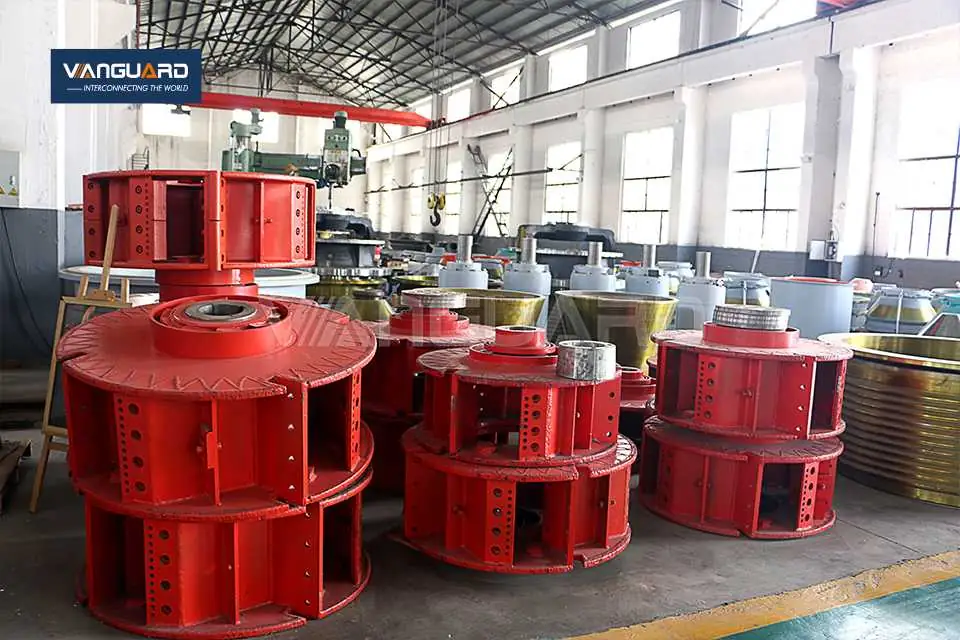
What Vanguard Machinery runs into again and again on customer sites comes down to this short list:
- Reading sand maker capacity without reading feed size: over 50 mm into a 5X and the nameplate capacity drops immediately - Putting an impact crusher on hard rock: on pebble and granite, blow bars go in two months, and the cone is cheaper per ton over the year - Washing out every trace of powder: when the MB value passes, powder is a useful component, and washing it all out costs you yield and buys you a wastewater problem - Sizing screens on average throughput: a sand maker's instantaneous peak can hit 1.5 times average, and the screen plugs - No room to work on the machine: the rotor is a high-frequency wear item, and without lifting clearance on both sides every change is a half-day teardown
FAQ
Shape and powder. Manufactured sand is angular with a rough surface, so it bonds better with cement and usually matches or beats natural sand on strength; the catch is that grading drifts coarse and powder runs high, so the sand maker and screens have to hold it together. Natural sand is round with lower water demand, but the resource keeps tightening.
Yes, provided the top size of your run-of-quarry is already under 40-50 mm. If you are digging out big boulders, skipping the secondary just overfeeds the sand maker, and capacity and yield fall together - a worse deal than paying for the extra stage. Vanguard Machinery looks at the actual top size before deciding what to drop.
Not advised. Pebble sits at Mohs 7-8 with high silica, and blow bars and liners wear extremely fast. Hard-rock sand lines run a 6CX jaw plus a CP cone up front; the investment is a little higher, but wear-part life is far longer and cost per ton of sand comes out lower.
Look at water and clay. Where water is short, or where the powder can be sold as a product, go dry with a classifier. Where the feed carries clay, or the customer is strict on cleanliness, go wet with a washer. Wet has to include fine-sand recovery, or everything below 0.075 mm leaves with the water.
Follow the MB value. At or below 1.4 there is little clay and the powder is a useful component, so around 10% is fine. Above 1.4 the clay is present and powder has to come down to under 5%. On a dry line you tune classifier extraction; on a wet line you tune how hard the washer works.
The usual build is a ZSW feeder into a 6CX jaw for primary, a CP cone for secondary, a 5X for sand making, and a double-deck screen for classification, with an XSD washer added on wet duty. On soft rock the CP can become a CI6X; on hard rock it stays a cone.
If you want shape and yield at higher tonnage, take the 5X - the deep-cavity rotor passes more and rock-on-rock gives rounder grains. For small to mid tonnage where budget leads, the VSI is cheaper to buy and simpler to keep. Vanguard Machinery decides from rock hardness and target yield, and hard-rock lines above mid tonnage almost always end up on a 5X.
Check three things. First, is the feed to the sand maker too coarse - above 50 mm and the yield collapses. Second, is a screen panel torn or blinded, so coarse grains never make it back into circulation. Third, is the circulating load high enough, because too little return drops the fine fraction. In most cases rotor speed and circulating load fix it.
Conclusion
The order matters and it cannot be reversed: set the product spec first (fineness modulus, grading zone, powder ceiling), then fix the front end from the parent rock (jaw plus cone for hard rock, impact allowed for soft), and only then size the sand maker and screens by tonnage. The sand maker is the only machine that truly makes sand; every stage before it is preparing feed.
Vanguard Machinery starts every sand line by asking for a bag of representative parent rock, then sets stages and models from measured hardness, clay and top size, leaving 15-20% throughput margin at every stage. If you are unsure how your own line should be configured, send the rock sample and your site dimensions and we will issue a configuration that actually works for your duty - easier than buying against a generic list.
Related Articles
• From Zhengzhou to Almaty: Vanguard Machinery to Exhibit at the 31st Kazakhstan K(2026-08-06)
• Vanguard Machinery to Exhibit at Construction Indonesia 2026, Deepening Its Sout(2026-08-06)
• The First Stage That Sets the Tone: Vanguard Machinery Brings the Tracked Mobile(2026-08-06)
• How to Choose a Mobile Crushing Plant Manufacturer...(2026-08-27)
• Best PFV1315 Impact Crusher for Limestone Crushing in Saudi ...(2026-08-06)
• How to Maintain a Crawler Type Mobile Jaw Crushing Plant(2026-08-05)
• Top 5 Reliable Crusher Alternatives to European Br...(2026-08-04)
• What Crushing Equipment Works Reliably at -40°C Without Brea...(2026-08-03)




