

Key Takeaways
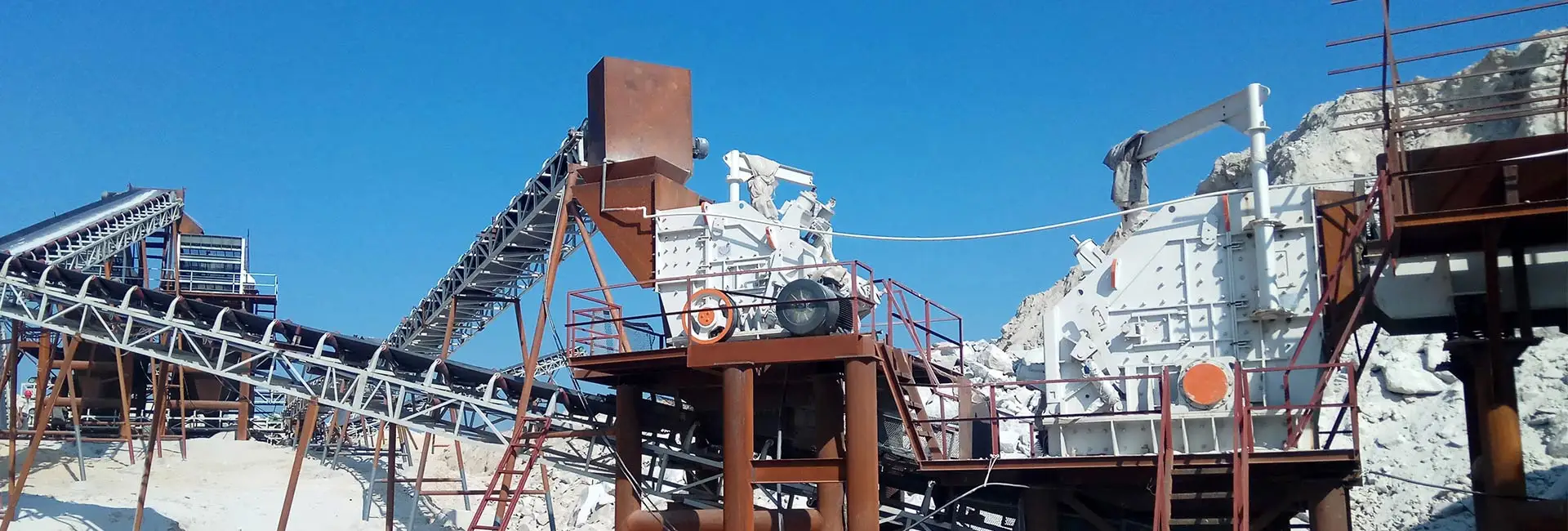
A 50 tph stone crushing plant is a common entry-level capacity. It is enough to self-supply aggregate for a batching plant or a construction project, the investment stays manageable and the payback is fast. But leave out any one piece and the line will not run.
- A 50 tph fixed line needs at least five equipment types: feeding, primary crushing, secondary crushing, screening and conveying - Hard rock (granite, basalt, river pebble) runs jaw plus cone; soft rock (limestone) runs jaw plus impact - 50 tph does not need three crushing stages; two stages are enough, with a 15-20% capacity margin on each machine - Supporting items get underestimated: belts, magnetic separator, dust control, foundations - all decide whether you actually ship spec product - Start selection with three questions: how hard is your rock, what size do you need, how wide is your site
Know Your Rock First: Hard or Soft
The same words "50 tph" mean two completely different plants for granite versus limestone. Fix the rock type first, then every later choice has a base.
- Hard rock: high compressive strength and abrasive. Granite, basalt and river pebble all count. Jaw plus cone is the rule; an impact crusher cannot take that abrasion and blow bars are gone in days - Soft rock: limestone and shale-like material, low abrasion. Jaw plus impact is cheaper, and impact shapes the product better - Feed size: excavator loads often run 400-500 mm on the long side, so the primary setting must match - Clay and moisture: heavy clay needs washing or pre-screening, and high moisture clogs screens and chambers
What Equipment a 50 tph Line Needs (by function)
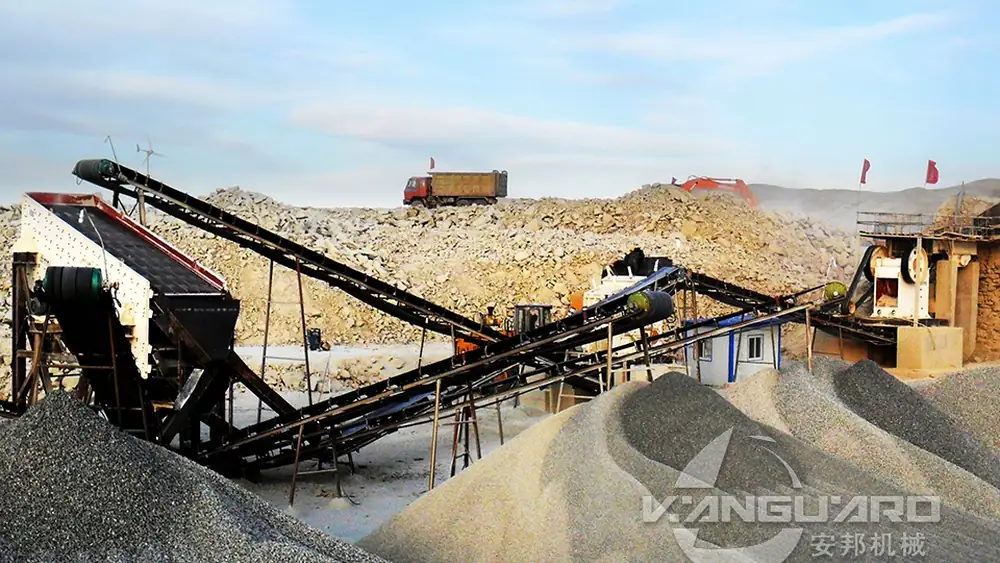
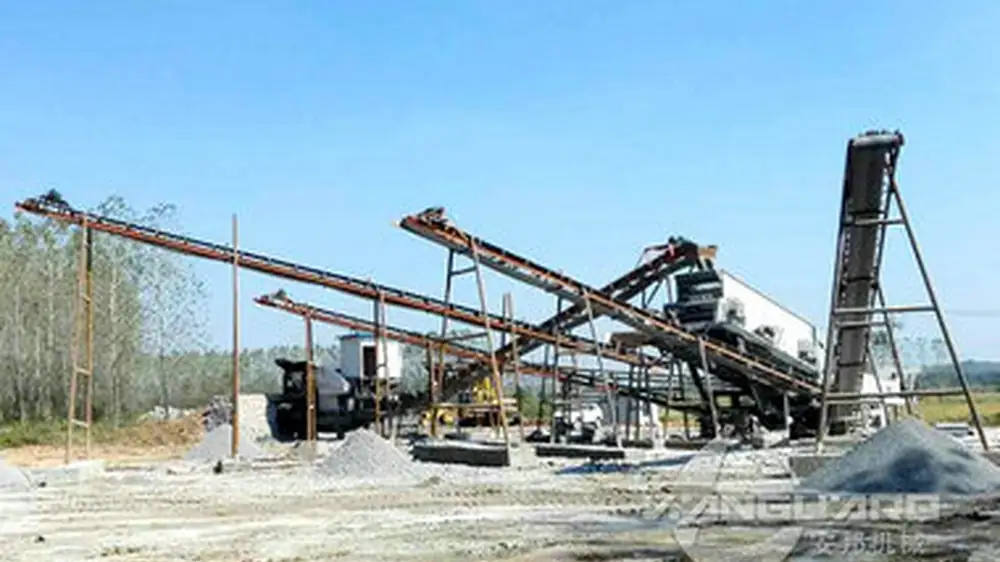
A stationary line spreads each machine out, every one doing a single job. Listed in material-flow order - miss one and the line stops.
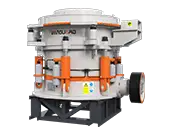
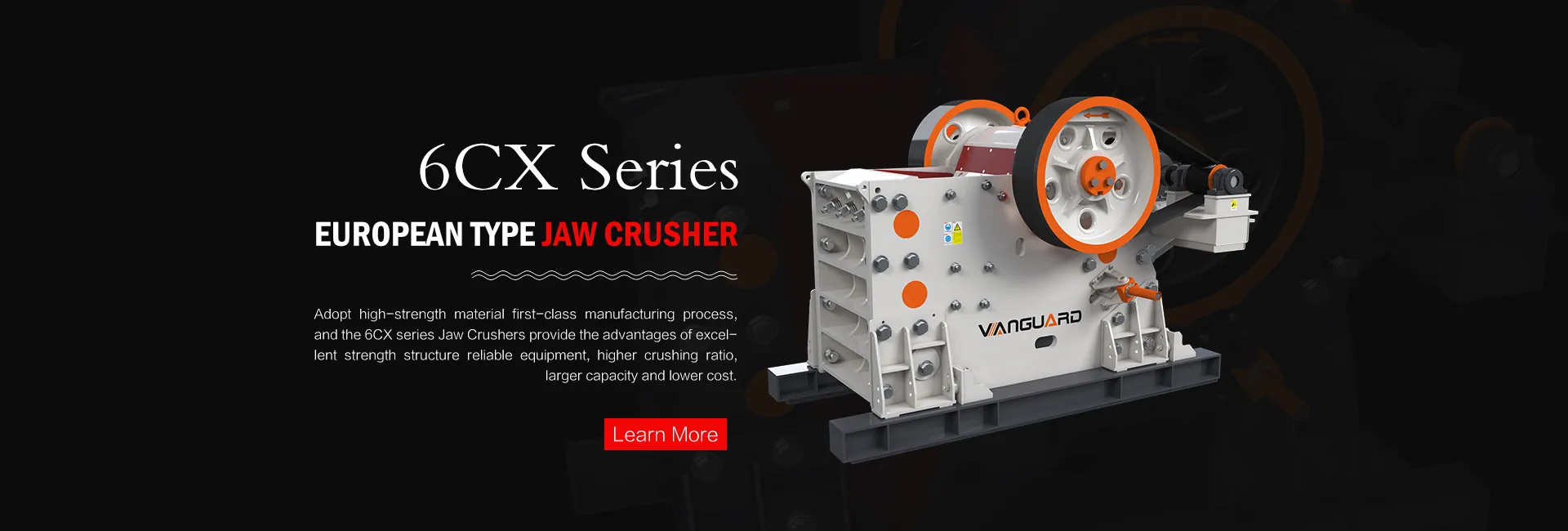
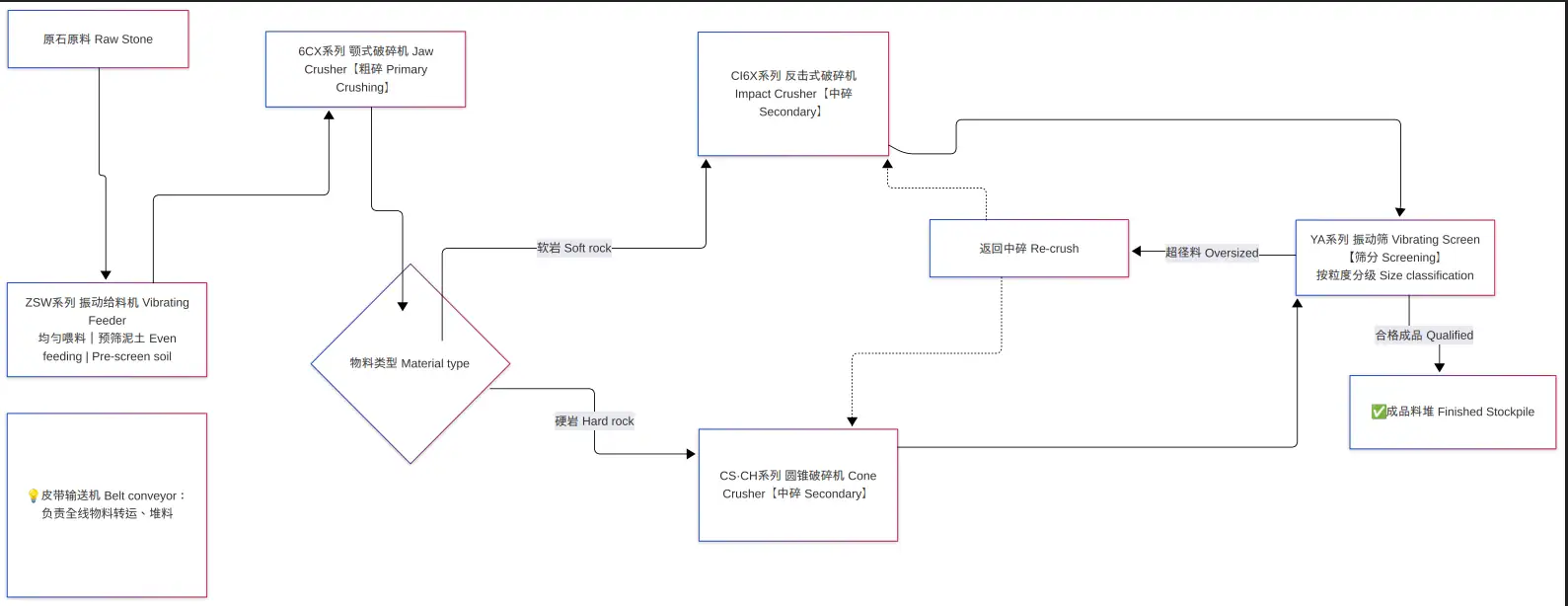
- Vibrating feeder (ZSW series): the first gate, even feeding plus pre-screening of clay, protecting the crusher behind it- Jaw crusher (6CX series): the primary workhorse, taking the big rock down to roughly 100 mm; every rock type starts here- Cone crusher (CS-CH series) or impact crusher (CI6X series): the secondary stage. Hard rock takes cone, soft rock takes impact- Vibrating screen (YA series): grades the crushed rock by size, sends oversize back to secondary and in-spec material to stock- Belt conveyors: link everything together - feeder to jaw to secondary to screen to stock, all moved by belt
Hard Rock vs Soft Rock (comparison)
The same 50 tph splits into two equipment camps by rock type. The table clears it in one view.
| Item | Hard rock (granite / basalt / river pebble) | Soft rock (limestone) |
| Primary | Jaw 6CX | Jaw 6CX |
| Secondary | Cone CS-CH | Impact CI6X |
| Product shape | Cone compression, good cube shape | Impact shaping, better shape |
| Wear parts | Jaw plates plus mantle, costly but long life | Blow bars wear fast but cheap |
| Typical product | High-grade concrete aggregate, railway ballast | Construction chips, base course |
| Investment | Slightly higher | Slightly lower |
Do not chase the lower price and put an impact crusher on hard rock. Once the abrasion hits, blow bars hit their limit in two weeks and the downtime for change-outs costs more than the saving. And do not force a cone onto soft rock either; the shaping ability of an impact crusher only shows on soft material.
A Typical 50 tph Configuration (with model reference)
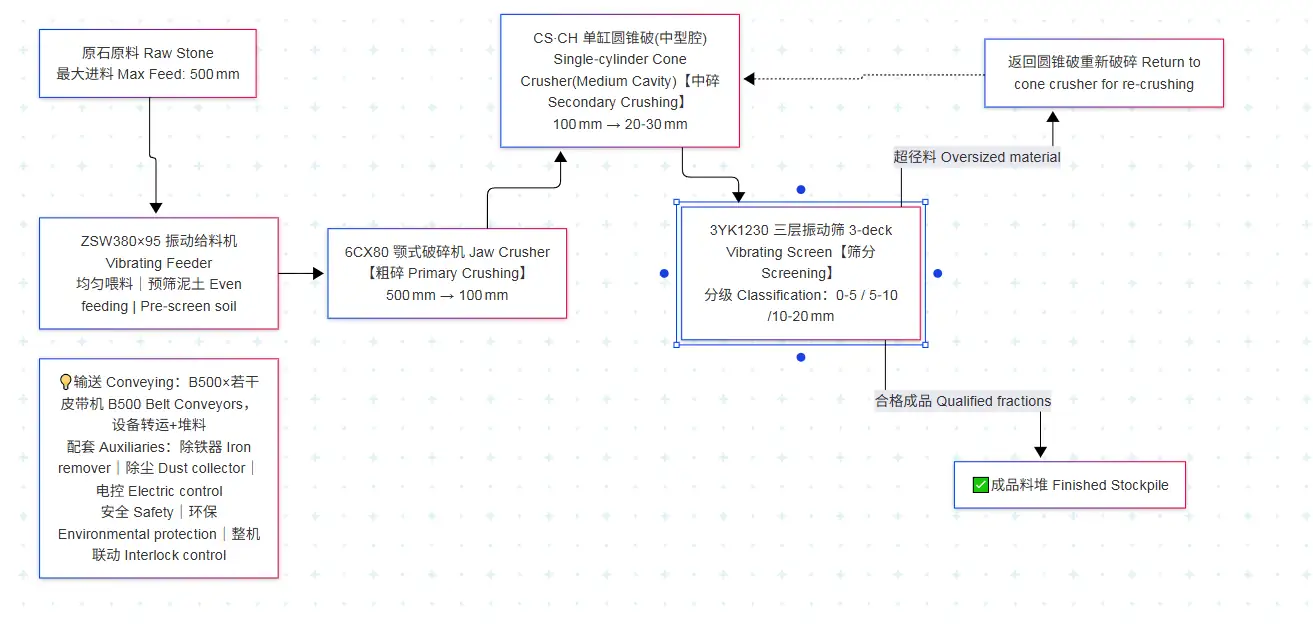
Below is a workable hard-rock 50 tph configuration. Models are written for common duty; tune them to your own rock.
| Station | Equipment (model reference) | Role |
| Feeding | ZSW380x95 vibrating feeder | Even feed, pre-screen clay |
| Primary | 6CX80 jaw crusher | Run-of-mine 500 mm to 100 mm |
| Secondary | CS-CH single-cylinder cone (medium cavity) | 100 mm to 20-30 mm |
| Screening | 3YK1230 vibrating screen (3 decks) | Grade 0-5 / 5-10 / 10-20 mm |
| Conveying | Belt B500 x several | Link machines, build stock |
| Auxiliary | Magnetic separator, dust collector, controls | Safety, environment, interlock |
This line picks the 6CX80 for primary because its feed opening is large enough to swallow 500 mm rock without struggle, and the capacity margin means the primary never becomes the bottleneck at full load. The secondary uses a single-cylinder cone with high automation and one-touch setting adjustment, which suits a site where nobody is watching the panel all day.
Three Questions to Pick the Right One
You do not need to memorise a spec sheet. Answer three questions and the choice falls out by itself.
- Question 1: how hard is your rock? Granite, basalt and river pebble go jaw plus cone; limestone goes jaw plus impact. This question sets the secondary crusher - Question 2: what size do you need? A single base-course grade needs one screen; 0-5 / 5-10 / 10-20 multi-grade needs a three-deck screen plus return - Question 3: how wide is your site? A narrow site shortens the conveyors and packs the machines; a wide site keeps maintenance access and stock piles
Once the three are answered, the equipment list is clear. The remaining model sizes are just back-calculated from the capacity margin. Vanguard Machinery field engineers also ask these three questions before quoting a line, because it is harder to get the configuration wrong than to just name a model.
Selection Steps: From Rock to Line
After the three questions set the direction, land the line in this order so nothing gets missed.
1. Sample the rock: take a representative sample, check hardness, abrasion, clay, moisture and maximum size 2. Set the stages: 50 tph needs two stages - hard rock jaw plus cone, soft rock jaw plus impact 3. Pick the primary: choose the jaw model by maximum feed size, leave margin on the feed opening 4. Pick the secondary: choose cone or impact by target size and rock type, match the cavity to the product 5. Pick the screen: set decks by number of product grades, leave margin on screen area against return load 6. Link the conveyors: set belt length and angle by machine spacing and drop 7. Set the foundations: concrete piers under feeder and crusher, steel platform under screen 8. Wire the controls: line-wide interlocked start-stop, commission empty before loading
When Vanguard Machinery issues a configuration drawing for a small line, it follows these eight steps - rock first, machine second, each step sized against the output of the previous one, so you never get a primary that cannot be fed or a secondary that gets overloaded.
Do Not Skip the Auxiliaries and the Site
The machines you can write on the list are only the main units. What really decides whether you ship product steadily is often the supporting kit.
- Belt conveyors: do not go too narrow. B500 is the floor for 50 tph, and keep the angle under 18 degrees or you get return spillage - Magnetic separator: raw rock hides rebar and steel; miss it and you dent the cone liners. Hang an RCYD right after the feeder - Dust control: crushing and screening are the two dustiest points, so fit bag filters or spray according to local rules - Site foundations: feeder and primary need concrete piers, screen needs a steel platform; weak foundations let the whole machine walk - Product yard: keep three piles for 0-5 / 5-10 / 10-20 plus a loadout lane, so the yard never chokes the output
Vanguard Machinery ships a 50 tph line with belts, magnet and dust control fitted to that standard, not just the main machines. Most site troubles are saved at the foundation or the auxiliaries, so spending a little more up front beats a few stopped days later.
FAQ
At least five types: one vibrating feeder, one jaw crusher, one secondary (cone or impact), one vibrating screen and several belt conveyors. A magnetic separator and dust collector depend on the case, but those five main types are non-negotiable - drop one and the line will not start. Vanguard Machinery's reference 50 tph package is built on exactly these five types plus belt, so you can check any quote against the list and see at once what is missing.
Not recommended. Granite and river pebble are highly abrasive, and impact blow bars wear out extremely fast on that material, often hitting their limit within a few hundred hours with frequent change-out downtime. Hard rock should run jaw plus cone; the wear parts cost more but last longer, so the unit cost is actually lower.
No. A 50 tph line is small, and two stages (primary plus secondary) already take run-of-mine down below 20 mm, then screening grades it into product. A third stage only adds cost and footprint unless you need very fine material or sand making.
By rock type. Hard rock (granite, basalt, river pebble) takes a cone crusher for compression strength and wear resistance; soft rock (limestone) takes an impact crusher for better shaping at a cheaper wear-part cost. Pick one of the two in a single line, do not stack both.
By the number of product grades. A single base-course grade needs two decks; 0-5, 5-10 and 10-20 three grades need a three-deck screen. One more deck means cleaner return and grading, but also more cost and height, so size it to the real need.
It does not crush, but it links feeding, crushing, screening and stockpiling. A belt at too steep an angle or too narrow a width spills return material and jams the line, capping the whole plant's capacity. For 50 tph use at least B500 and keep the angle below 18 degrees. Vanguard Machinery sizes the 50 tph belt set at B500 minimum with the angle held under 18 degrees, because that is the point where most small lines quietly lose capacity.
Yes, but keep maintenance access. Feeder, jaw, cone and screen can be packed close with shorter belts to save footprint. But leave room on the side of each machine for a person to change liners and tighten bolts, or later maintenance becomes impossible. Vanguard Machinery's layout drawings mark the service aisle on every machine, because a line you cannot reach is a line you cannot maintain.
With main machines and auxiliaries, a small hard-rock line typically sits in the low hundreds of thousands of RMB, and soft rock is a bit lower. It depends on rock type, product grades and automation. The price Vanguard Machinery quotes for a 50 tph hard-rock line already includes those wear-part differences, so measure the rock before comparing prices - the same nominal 50 tph costs more on hard rock because the wear parts cost more.
Conclusion
A 50 tph stone crushing plant looks simple, but to ship product steadily you cannot miss any of the five main types: feeding, primary jaw, secondary cone or impact, screening and conveying. Hard rock runs jaw plus cone, soft rock runs jaw plus impact - those are the two routes that do not go wrong. Do not rush to model numbers; sample the rock accurately and answer the three questions first, and the equipment list becomes clear on its own.
For a 50 tph plant the equipment list is standard, but the model sizes and capacity margins are what decide whether the line actually earns. Vanguard Machinery sends a field engineer to confirm rock and site before the machines are cut, so a small line does not turn into a small headache.
Vanguard Machinery sizes small lines by first asking for a bucket of representative run-of-mine, then sets the stages and models by hardness, abrasion, clay and moisture, and back-calculates each machine model and capacity margin. If you are unsure how to configure your own line, send the rock sample and site dimensions and we will issue a workable configuration for your duty - that is easier than buying against a generic list.
Related Articles
• From Zhengzhou to Almaty: Vanguard Machinery to Exhibit at the 31st Kazakhstan K(2026-08-06)
• Vanguard Machinery to Exhibit at Construction Indonesia 2026, Deepening Its Sout(2026-08-06)
• The First Stage That Sets the Tone: Vanguard Machinery Brings the Tracked Mobile(2026-08-06)
• How to Choose a Mobile Crushing Plant Manufacturer...(2026-08-27)
• Best PFV1315 Impact Crusher for Limestone Crushing in Saudi ...(2026-08-06)
• How to Maintain a Crawler Type Mobile Jaw Crushing Plant(2026-08-05)
• Top 5 Reliable Crusher Alternatives to European Br...(2026-08-04)
• What Crushing Equipment Works Reliably at -40°C Without Brea...(2026-08-03)




