

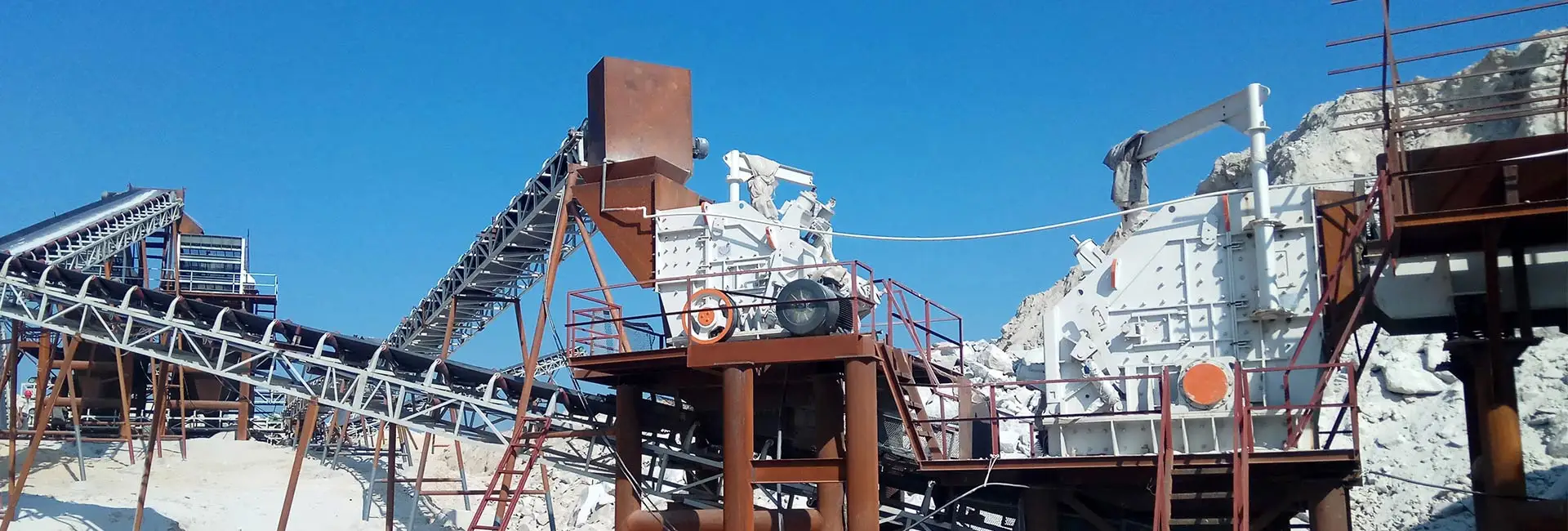
Key takeaways:The CI6X Series Impact Crusher is a horizontal-shaft impact crusher built for the coarse and medium crushing stages of large aggregate and mining lines, where shape and cost matter as much as tonnage. Its involute crushing chamber delivers a more cubical product and a high reduction ratio in a single pass. It fits soft to medium-hard, low-abrasive rock such as limestone, dolomite, weathered rock, construction and demolition waste, and coal. For hard abrasive rock like granite, basalt or river pebble, a jaw plus cone setup is the right choice instead.
Introduction
In aggregate and mining lines, the coarse and medium stages always face the same tension: capacity, shape, wear and cost rarely move in the same direction. The CI6X Series Impact Crusher is designed to break that trade-off. By crushing with impact rather than compression, it produces stone with fewer edges, a lower flake index and a higher cubical ratio, while holding a stable gradation at high feed and high capacity. This article walks through the machine from a product perspective.
1. What Is the CI6X Series Impact Crusher?
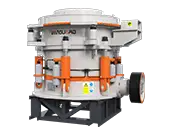
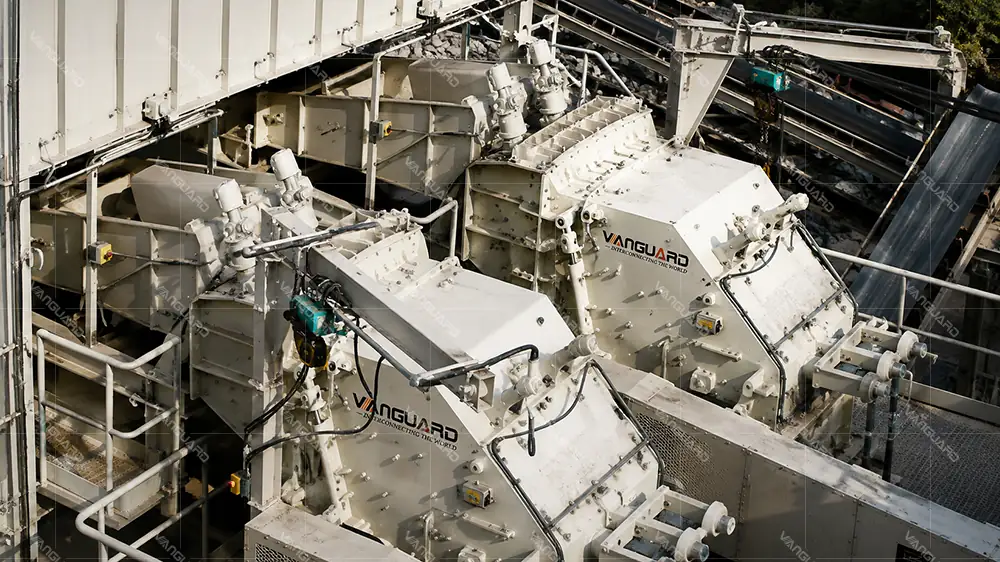
The CI6X Series Impact Crusher is a horizontal-shaft impact crusher, or HSI, used for primary and secondary crushing of soft to medium-hard, low-abrasive rock. At its core is a high-inertia rotor fitted with blow bars. As the rotor spins fast, it throws material against a specially shaped crushing chamber, where the stone is reduced by repeated impact against the impact plates rather than by being squeezed between two jaws. That mechanism is exactly why the product has fewer corners, a low elongated fraction and a high cubical ratio.
In positioning, CI6X is a large, intensive coarse and medium crusher, common in fixed high-capacity aggregate lines and often used as the core crusher of mobile or semi-mobile plants. Its capacity spans roughly 150 to 2000 tons per hour, with installed power from about 160 to 1200 kilowatts, and models scale with line size.
2. Why Choose the CI6X?
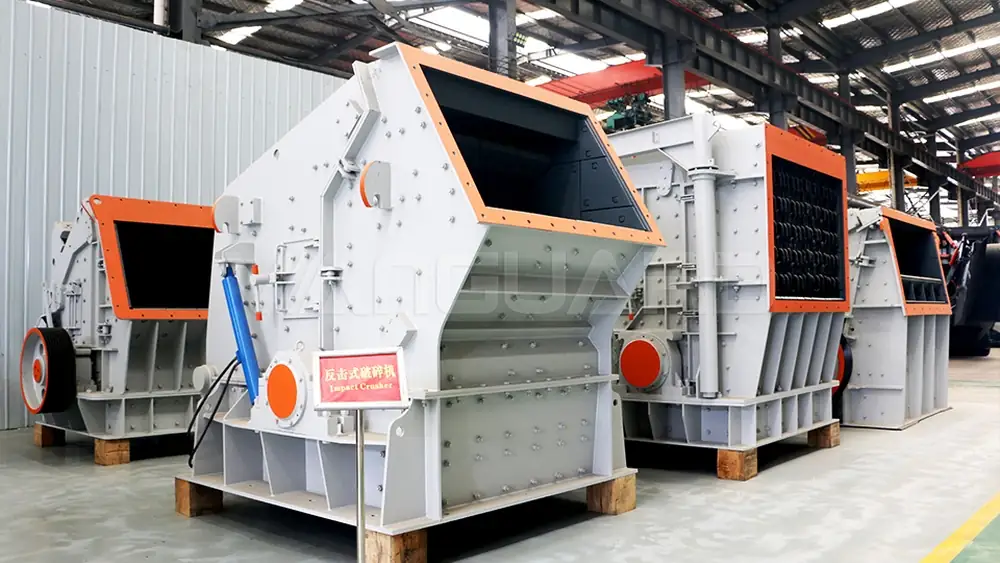
Choosing CI6X means choosing higher-value aggregate and a lower cost per ton. First, shaping: the involute chamber makes material strike the impact plate at a near-vertical angle, so stone breaks along natural fractures and the cubical ratio is clearly higher than compression machines, which matters for concrete, asphalt and railway ballast with strict shape needs. Second, reduction ratio: a single stage can take large feed down to a small product size and cut the number of crushing stages. Third, cost per ton: on low-abrasive rock, blow bars and liners last long and specific energy stays low, so running economics are strong. Fourth, serviceability: hydraulic discharge adjustment and hydraulic top opening make wear-part changes and chamber access far easier.
The advantage only holds when the material fits. Put CI6X on the right soft to medium-hard, low-abrasive rock and the payoff is large; put it on the wrong rock and wear and downtime rise fast.
3. Key Features
Several design points decide the performance and usability of CI6X. One is the involute crushing chamber: material hits the impact plate at a near-vertical angle, impact is fuller, shape is better and flakiness is lower. Two is the heavy-duty integrated welded rotor: a large-diameter, high-precision welded structure with high rotational inertia, stable running and small start-current fluctuation that absorbs impact load at high capacity. Three is fully hydraulic discharge adjustment and hydraulic top opening: the hydraulic system quickly sets the discharge setting and lifts the upper cover for blow-bar changes and inspection, cutting downtime. Four is precise bearing-seat positioning that keeps rotor assembly accuracy and long-term concentricity. Five is a fast-disassembly blow-bar design that lets bars be pulled from the rotor side without complex tooling.
Together these features balance high capacity, good shape and easy maintenance.
4. How It Works
The CI6X process has four steps. First, feed: material is fed evenly into the chamber and lands on the fast-spinning rotor. Second, acceleration and throw: the blow bars accelerate the stone to high speed and fling it tangentially. Third, in-chamber impact: the stone hits the first impact plate, rebounds, is thrown again by the rotor to the second plate, and is broken repeatedly between blow bar, plate and stone-on-stone collisions. Fourth, discharge and sizing: material at size leaves through the bottom discharge and goes to screening, while oversize returns to the chamber until it qualifies.
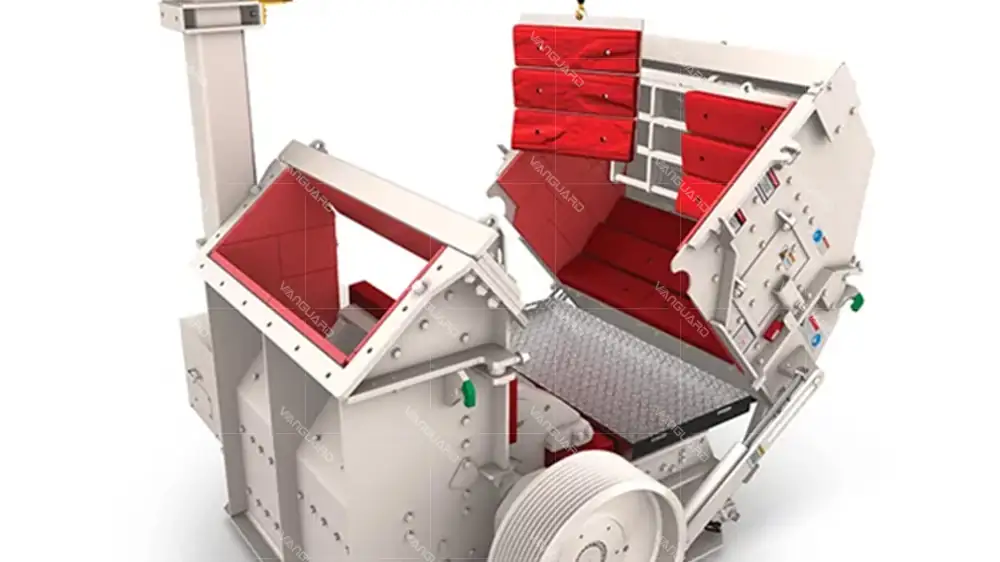
The whole process is impact fragmentation, not compression, which is the root reason impact crushers shape better than jaw or cone crushers. The hydraulic discharge setting directly controls the top size and the capacity balance.
5. Applications and Suitable Materials
CI6X fits large aggregate lines, limestone cement-raw lines, coal and power-plant fuel crushing, construction and demolition waste recycling, and weathered soft-rock coarse and medium crushing. The best-fit material is low Mohs hardness, low abrasiveness, moderate clay and moisture. Typical feeds are limestone, dolomite, weathered rock, soft shale, coal, and concrete or brick from demolition.
By contrast, CI6X is not for high-hardness, high-abrasive rock. Granite, basalt, quartzite and river pebble, around Mohs 7 to 8, wear blow bars and plates extremely fast, driving wear-part cost out of control and stopping the line often. For such hard rock, prefer a jaw crusher for primary and a cone crusher, such as the CP, CS or CH series, for secondary and tertiary. That is a hard selection rule.
6. Technical Specifications
The table below shows the typical CI6X lineup and reference parameters. Rotor diameter grows with model size, and maximum feed, capacity and installed power are given as typical ranges. Final figures depend on material, product size and plant layout and are confirmed in the technical agreement.
| Model | Rotor diameter (mm) | Max feed (mm) | Capacity (t/h) | Power (kW) |
| CI6X1110 | 1100 | 500 | 150–300 | 160–250 |
| CI6X1213 | 1210 | 600 | 250–450 | 200–315 |
| CI6X1313 | 1300 | 600 | 300–550 | 250–400 |
| CI6X1315 | 1310 | 700 | 350–600 | 250–400 |
| CI6X1415 | 1410 | 800 | 450–750 | 315–500 |
| CI6X1520 | 1520 | 800 | 500–900 | 400–630 |
| CI6X1620 | 1620 | 900 | 600–1100 | 500–800 |
| CI6X2023 | 2020 | 1300 | 900–2000 | 800–1200 |
The lineup covers the full gradient from medium to very large capacity. Small models suit 150 t/h-class lines, while CI6X2023 supports near 2000 t/h aggregate bases.
7. How to Choose the Right Model?
Selection turns on four variables. First, capacity target: work back from the finished tonnage to the needed throughput and leave 10 to 20 percent margin. Second, feed size: maximum feed must stay under the model limit, or the chamber clogs and the blow bars overload. Third, product size and shape: when a high cubical ratio and low flakiness are required, CI6X is the priority; finer product needs more power and more return. Fourth, abrasiveness: only low-abrasive rock suits an impact crusher, so hard rock should switch to jaw plus cone.
Practical advice: run a process calculation on a material sample to set the number of stages and the load per stage, then pick the model closest to the target capacity to avoid driving a small machine hard or wasting a large one. Vanguard Machinery can supply material analysis and stage calculation to keep the model in the best value band.
8. CI6X in a Complete Crushing Plant
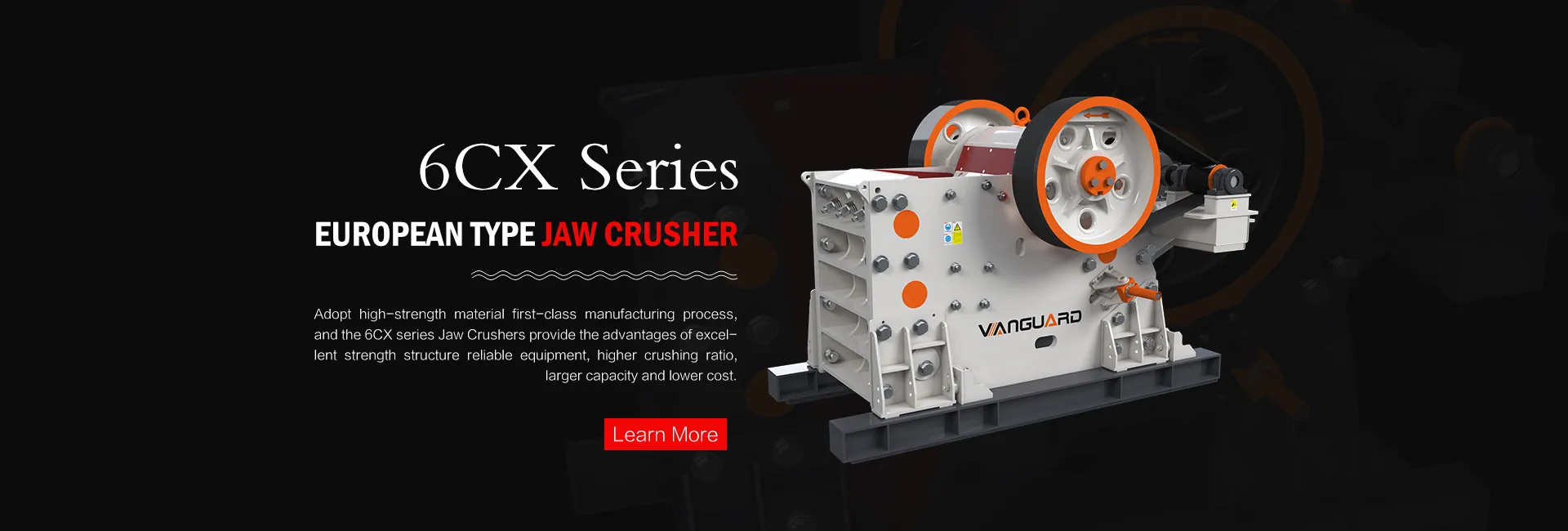
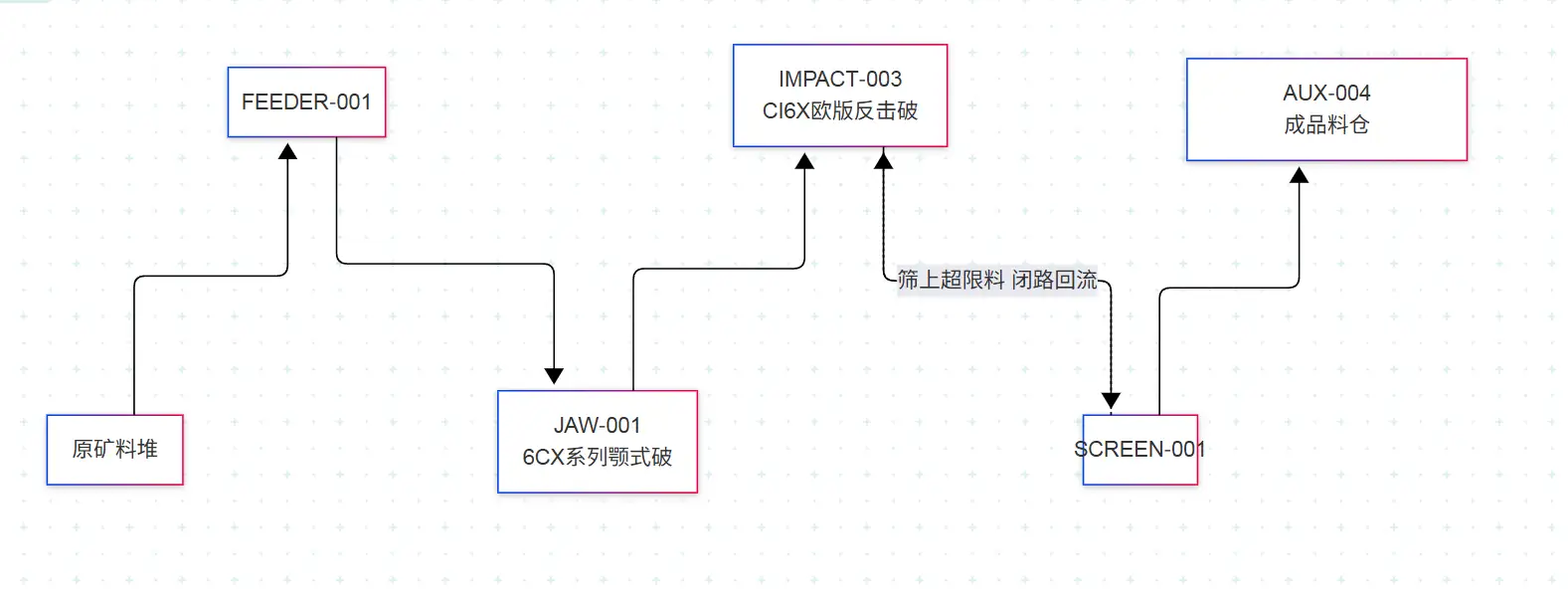
In a typical three-stage line, CI6X usually takes the secondary role. Primary crushing by a jaw crusher, such as the 6CX series, drops run-of-mine rock to a size that can enter the impact crusher. CI6X then reduces it to a screen-ready size, and oversize from screening returns to CI6X in a closed circuit while in-spec material goes to the product bins. This jaw-primary plus impact-secondary plus closed-circuit screening combination is one of the classic and most economical setups for limestone aggregate lines.
CI6X can also act as a single primary on soft rock: when the feed is soft and moderately sized, a large-feed model can crush it to a mid size in one pass, removing a whole stage and cutting capital cost. Either way, CI6X belongs in the low-abrasive, shape-demanding part of the flow.
9. Project Case
The following is an illustrative limestone aggregate project, anonymous and for configuration reference only, pointing to no specific client or verifiable record. Background: a limestone quarry needed a construction aggregate line at about 300 tons per hour, supplying concrete and road base with clear shape and gradation requirements.
Configuration: primary crushing used a 6CX jaw crusher to take run-of-mine rock below about 200 mm. Secondary crushing used one CI6X impact crusher to reduce material into the 0 to 40 mm range. A circular vibrating screen then ran a closed circuit, returning oversize to the CI6X and grading in-spec material into 0 to 5, 5 to 10, 10 to 20 and 20 to 40 mm bins. Running closed loop, the CI6X involute chamber produced a high cubical ratio, with flakiness clearly lower than a pure compression process.
Outcome: on this low-abrasive limestone, CI6X blow bars lasted long and specific energy stayed low, while the return load kept gradation stable. The line reached its design rate near 300 t/h and the product shape met concrete and asphalt specs. The case shows that placing CI6X in a soft-rock, closed-circuit, shape-demanding scenario captures both capacity and quality.
10. CI6X vs Alternatives
Comparing CI6X with common machines clarifies its place. Against the 6CX jaw crusher: the jaw is the primary workhorse by compression, tough on hard rock and wear-resistant, but flatter in shape and lower in reduction ratio; CI6X does secondary with better shape and a bigger ratio, yet not on hard abrasive feed. Against cone crushers, the CP, CS or CH series: cone is the first choice for medium-hard and above, wear-resistant and hard-rock capable, but shape is poorer than impact; CI6X wins on soft to medium-hard rock for shape and cost. Against hammer crushers, the PCZ series: hammer is simple and gives a large single-stage ratio, good for medium-hard brittle rock, but sensitive to sticky and abrasive feed; CI6X is steadier on large capacity and shape control. Against vertical-shaft impact crushers, the VSI 5X series: VSI is the sand-making and final-shaping machine at the fine end, turning fine feed into sand and high-shape aggregate; CI6X handles the earlier coarse and medium stage, so they complement rather than replace each other.
Positioning in one line: hard rock goes jaw plus cone; soft to medium-hard, low-abrasive rock with shape needs goes jaw plus impact, and CI6X carries the high-shape coarse and medium duty in that path.
11. FAQ
No. Granite, basalt and river pebble are high-hardness, high-abrasive rock where blow bars and plates wear far too fast and cost runs away. For such hard rock, use a jaw plus cone setup instead.
The jaw handles primary crushing, taking large run-of-mine rock down to a size that can enter the impact crusher. CI6X handles secondary, reducing to a screen-ready size while shaping. They are usually in series.
Because it fragments by impact along natural fractures, not by compression, and the involute chamber makes material strike the impact plate near vertically, so the cubical ratio is high and flakiness is low.
Through a fully hydraulic discharge adjustment system that quickly changes the setting and the capacity balance, with no major teardown.
Not really. CI6X uses a fast-disassembly blow-bar design that pulls bars from the rotor side, and with hydraulic top opening the downtime is much shorter than traditional structures.
It depends on the model. The series maximum feed is about 500 to 1300 mm, and routine feed should stay in a lower sensible range to avoid chamber clogging. See the specifications table.
Yes. Concrete and brick from demolition are low-abrasive, and CI6X crushes them efficiently into reusable aggregate, a common host in recycling lines.
Fix the material nature, hardness, abrasiveness, clay and moisture, plus target capacity and product size, then calculate stages and match the model. Material fit is the premise.
On soft rock with moderately sized feed it can, as a large-feed model can crush to a mid size in one pass and remove a stage. Hard rock or very large lumps still need jaw primary.
Vanguard Machinery can provide material analysis, stage calculation, selection of CI6X with matching jaw, cone and screening equipment, plus installation guidance and spare-part advice to keep the line in the best value band.
Related Articles
• What Is an Impact Crusher? How It Works, Types and How to Choose(2026-07-17)
• Hydraulic vs Spring Cone Crusher: What Sets Them Apart and How to Choose(2026-07-22)
• Why Is My Jaw Crusher Wearing Out Too Fast? Causes and Fixes(2026-07-09)
• 200 t/h Limestone Crushing-and-Sand-Making Plant in Malaysia: Five-Size Mobile Line
• 300 TPH Mobile Crusher: Configuration, Capacity and Selection(2026-07-22)
• Crawler Mobile Crusher Price: What Drives the Cost of a Crawler Plant(2026-07-20)
• Why Choose a Crawler Mobile Crusher?(2026-07-15)
• Vanguard Machinery Showcases Mobile Crushing and Screening Plants at MINEENTRA 2026 Zimbabwe




