

Key Takeaways
Picking a grinding mill starts with the mesh you need: 200 mesh coarse, 325 mesh standard, 800 mesh fine, 2500 mesh ultrafine - each band maps to a different mill family.
- 200-325 mesh runs a high-pressure suspension mill (YGM) or a large-capacity vertical mill (LM); 325-2500 mesh runs a micro powder mill (HGM) or an ultrafine vertical mill (LUM) - The finer you go, the stricter the demand on roller/ring material, classifier and sealing - and the higher the price - Three questions decide the choice: target fineness, hourly capacity, material hardness and moisture - At the same nominal fineness, hard rock wears faster and grinds slower - always send a sample first - One mill changes fineness with the classifier, not by swapping rollers; ultrafine needs a high-efficiency classifier
Know Your Target Fineness First: What 200 / 325 / 800 / 2500 Mesh Mean
Mesh counts the holes per inch of screen; the higher the mesh, the finer the powder. On one mill, you usually change fineness with the classifier, not by swapping rollers.
- 200 mesh: coarse powder, used in dry-mix mortar, brick and some fillers - 325 mesh: standard industrial powder, common in coatings, plastics, rubber, feed additives - 800 mesh: fine powder, used in premium fillers, coatings, sealants - 2500 mesh: ultrafine powder, used in premium paper, cosmetics, functional fillers
Break It Down by Fineness: Which Mill for Each Band
- 200 mesh: a YGM high-pressure suspension mill (or an LM vertical mill for high tonnage)- 325 mesh: YGM is still the cheapest; if you also need finer later, go straight to an HGM micro powder mill- 800 mesh: an HGM micro powder mill or an LUM ultrafine vertical mill- 2500 mesh: both HGM and LUM reach 2500 mesh; pick by capacity and brightness
Vanguard Machinery's four mill families cover the whole 200-2500 mesh range, so one supplier fits the whole line.
Fineness-to-Mill Comparison
| Target fineness | Recommended mill | Typical product fineness | Notes |
| 200 mesh | YGM high-pressure / LM vertical | 30-425 mesh | coarse, high-tonnage first choice |
| 325 mesh | YGM (cheap) / HGM (also finer) | 325 mesh | mainstream standard powder |
| 800 mesh | HGM micro / LUM ultrafine | 325-2500 mesh | fine powder, fillers |
| 2500 mesh | HGM / LUM | up to 2500 mesh | ultrafine, functional fillers |
Four Mill Families at a Glance
| Mill | Feed size | Product fineness | Capacity | Best for |
| YGM high-pressure | <=35 mm | 30-425 mesh | medium | 200-325 mesh |
| LM vertical | <=50 mm | 80-400 mesh | large | 200-325 mesh, high ton |
| HGM micro | <=20 mm | 325-2500 mesh | medium | 325-2500 mesh |
| LUM ultrafine | <=20 mm | 400-2500 mesh | medium-large | 800-2500 mesh |
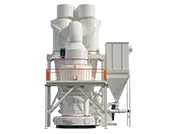
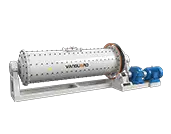
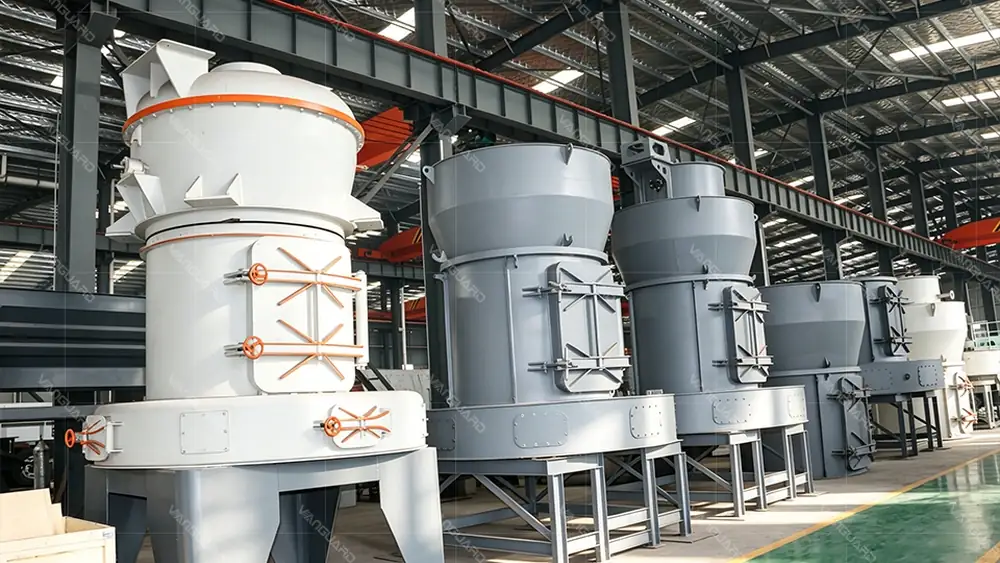
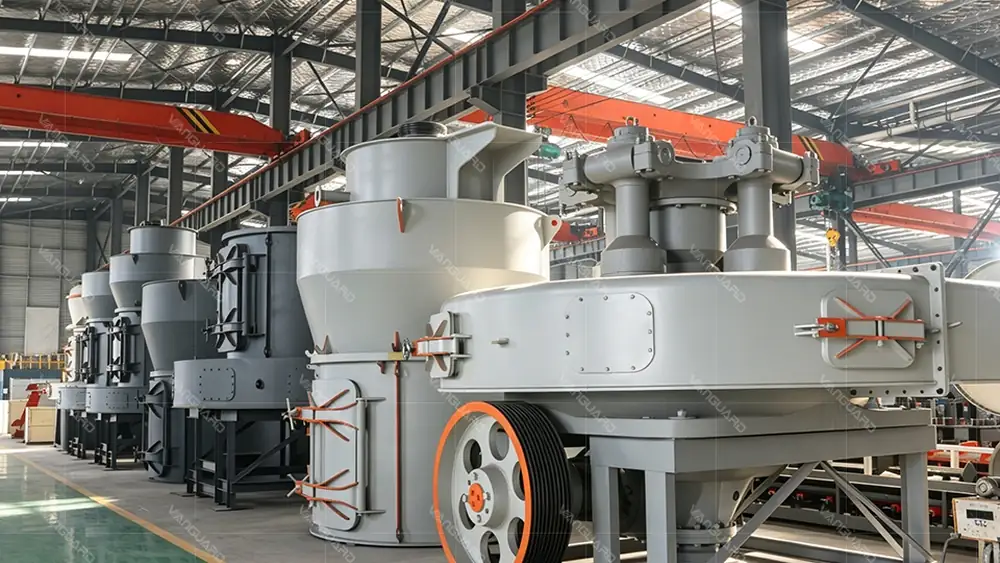
- YGM high-pressure suspension mill: spring-loaded rollers press the ring; mature, low investment, cheapest at 200-325 mesh - LM vertical mill: material is pressed on a rotating table with built-in drying; high tonnage, low power, best for large 200-325 mesh output - HGM micro powder mill: three-ring medium-speed mill with multi-layer rollers; covers 325-2500 mesh, first choice for small-medium ultrafine - LUM ultrafine vertical mill: vertical ultrafine; high product whiteness, tight particle distribution, quality-first at 800-2500 mesh
Vanguard Machinery builds all four families to the same wear and sealing standard, so you change model, not supplier.
Three Questions to Pick the Right One
You do not need to memorise a spec sheet. Answer three questions and the mill family falls out by itself.
- Question 1 - fineness: do you need 200, 325, 800 or 2500 mesh? The mesh locks the mill family - Question 2 - capacity: high tonnage goes LM; medium goes YGM / HGM; ultrafine high tonnage goes LUM - Question 3 - material: hard rock (quartz, feldspar) wears fast, wet rock needs drying, powdery feed needs pre-treatment - these set the model and auxiliaries
Once the three are answered, the equipment list is clear. Vanguard Machinery field engineers also ask these three questions before quoting a line, because it is harder to get the configuration wrong than to just name a model.
Selection Steps
1. Set target fineness and use: write down the mesh and what it is for 2. Sample test: send a representative sample, check hardness, moisture, powder content and max size 3. Pick family by fineness: 200-325 goes YGM/LM, 325-2500 goes HGM/LUM 4. Pick model by capacity: size the main machine within the family, leave 15-20% margin 5. Fit the classifier: ultrafine needs a high-efficiency classifier that sets the final mesh 6. Fit dust collection and feed: pulse-jet dust collector plus even feed plus product silo 7. Set foundation and drying: wet rock uses vertical-mill hot air or pre-drying 8. Empty run then load: interlocked start-stop across the line, idle first then feed
Vanguard Machinery issues a grinding-line configuration drawing following these eight steps - rock first, machine second, each step sized against the output of the previous one, so you never get a primary that cannot be fed or a classifier that is overloaded.
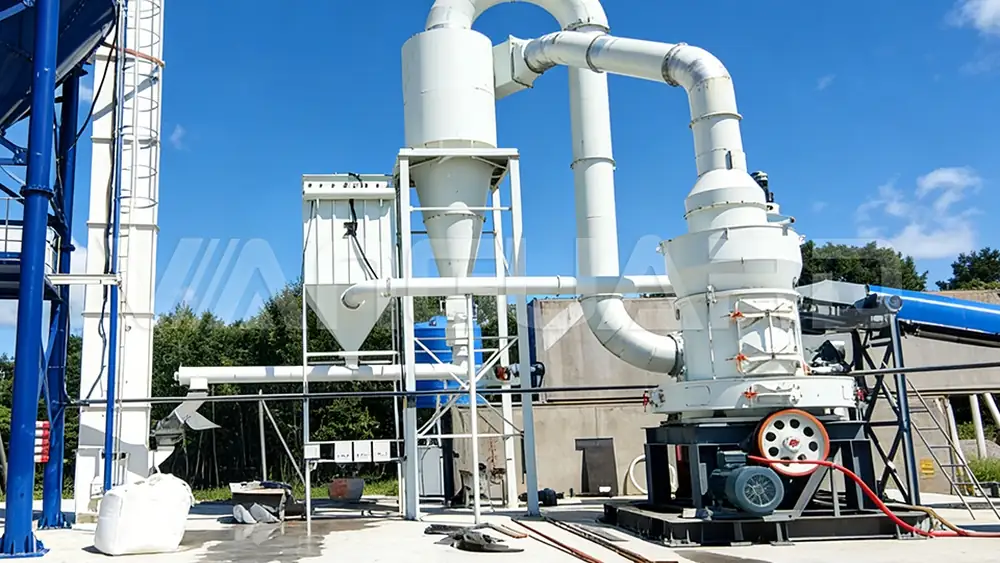
Auxiliaries and the System
What really decides whether you ship powder steadily is often the kit outside the main machine.
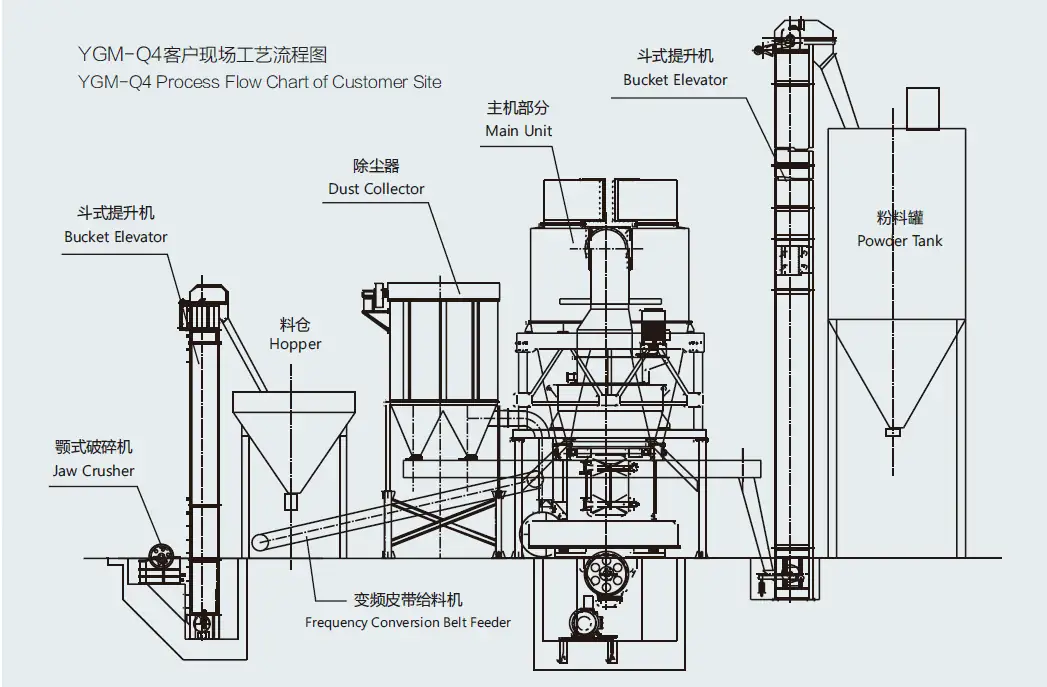
- Classifier: the gatekeeper of final fineness; ultrafine needs a high-efficiency turbine classifier to send coarse particles back - Dust collection: grinding throws dust everywhere; only a pulse-jet bag filter passes environmental checks - Feed and storage: even feed prevents choking, a product silo prevents packing - Foundation and drying: wet rock needs vertical-mill hot air or pre-drying, or the mill chokes
Vanguard Machinery fits the classifier, dust collector and dryer to the main machine standard, not just selling you the host. Most site troubles are saved at the auxiliaries, so spending a little more up front beats a few stopped days later.
FAQ
Yes. The YGM high-pressure suspension mill covers 30-425 mesh, so both 200 and 325 mesh are inside the range; just tune the classifier. One mill serves two bands.
To reach 800 mesh, YGM cannot get there; you need an HGM micro powder mill or an LUM ultrafine vertical mill. Vanguard Machinery recommends HGM for small lines and LUM when brightness matters.
Both HGM and LUM hold 2500 mesh steadily. Pick by capacity and brightness: large tonnage and brightness-first goes LUM; small-medium tonnage and cost control goes HGM.
Rough rule: mesh is about 15000 divided by microns (um). So 325 mesh is about 45 um, 800 mesh about 18 um, 2500 mesh about 5 um.
Quartz is Mohs 7 and wears hard. Use wear-resistant roller/ring material; HGM fits better. The classifier must resist wear, check the product screen often, and keep wear parts in stock.
Yes. The same HGM/LUM switches between 325 mesh and 800 mesh by classifier speed; to also cover 200 mesh coarse, add screening or switch to a YGM. Vanguard Machinery usually keeps HGM as the base and adds LUM when brightness rises.
Finer is slower: the same host at 2500 mesh makes far less than at 325 mesh. Always leave capacity margin on the ultrafine band; do not quote fine output at coarse capacity.
It depends on hourly capacity and material. The price Vanguard Machinery quotes follows your sample and site size; hard rock costs more because wear parts cost more, so measure the rock before comparing prices.
Conclusion
To pick a grinding mill, read the mesh first, then the family: 200-325 mesh goes YGM or LM, 325-2500 mesh goes HGM or LUM. The finer you go, the stricter the demand on roller material, classifier and sealing - and the higher the price, so do not look only at the host price.
Vanguard Machinery sizes grinding lines by first asking for a bucket of representative run-of-mine, then sets the stages and models by hardness, abrasion, clay and moisture, and back-calculates each machine model and capacity margin. If you are unsure how to configure your own line, send the rock sample and site dimensions and we will issue a workable configuration for your duty - that is easier than buying against a generic list.
Related Articles
• From Zhengzhou to Almaty: Vanguard Machinery to Exhibit at the 31st Kazakhstan K(2026-08-06)
• Vanguard Machinery to Exhibit at Construction Indonesia 2026, Deepening Its Sout(2026-08-06)
• The First Stage That Sets the Tone: Vanguard Machinery Brings the Tracked Mobile(2026-08-06)
• How to Choose a Mobile Crushing Plant Manufacturer...(2026-08-27)
• Best PFV1315 Impact Crusher for Limestone Crushing in Saudi ...(2026-08-06)
• How to Maintain a Crawler Type Mobile Jaw Crushing Plant(2026-08-05)
• Top 5 Reliable Crusher Alternatives to European Br...(2026-08-04)
• What Crushing Equipment Works Reliably at -40°C Without Brea...(2026-08-03)




