

Key Takeaways
A vibrating screen is not the "star" like a crusher, but it decides the quality and output of your finished material. Oversize it and you waste capital and floor space; undersize it and screening is incomplete, material piles up and the whole line loses efficiency. Size it scientifically from capacity, deck area, deck number, aperture, material and installation together — not just the nameplate tonnage of one unit. Vanguard Machinery's YA series circular vibrating screen covers grading from small to very large aggregate lines.
1. Know the screen's role in your line
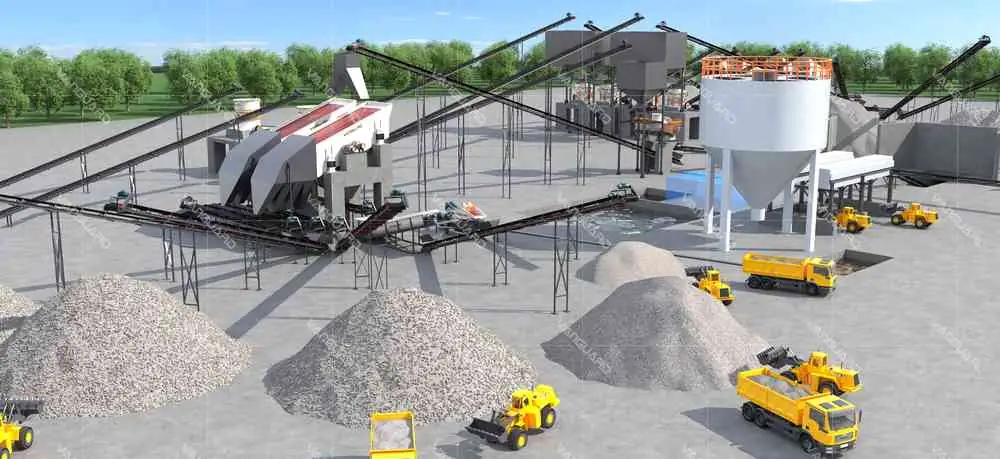
The screen's job is classification — splitting post-crush mixed material by size into finished grades. In a complete line it shows up at three points: - Pre-screening: remove fines before crushing, cut crusher load, lift system throughput - Closed-circuit screening: with the crusher, return off-spec material for re-crush - Product screening: split final grades by size (e.g. 0–5, 5–10, 10–20, 20–30 mm) Different roles want different things: pre-screen values throughput; product screen values precision. Fix the screen's position in your line first, then size it. Vanguard Machinery sizes screens this way across its aggregate lines.
2. Six core factors in screen sizing
Capacity is the first parameter. Two points: line design tonnage (200 t/h, 500 t/h); screen capacity should exceed the upstream crusher by 10%–20% to avoid pile-up on the deck. Example: a 200 t/h crusher should pair with a screen rated no lower than 220–240 t/h.
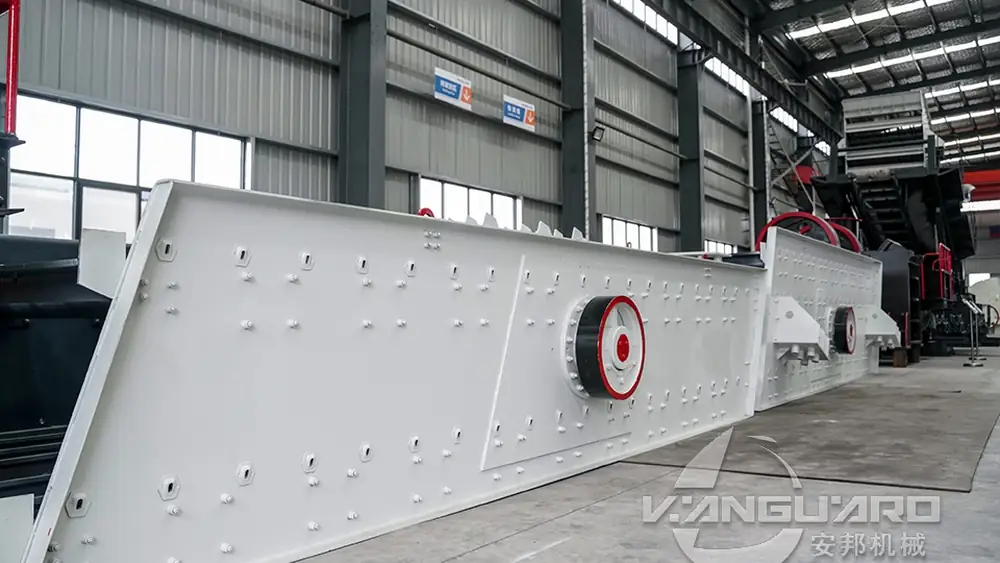
Deck area decides capacity; the L:W ratio decides efficiency:- Width: decides carrying capacity (how much material per unit time); wider = thinner bed = higher pass-through chance- Length: decides efficiency and precision; longer = more residence time = more thorough- L:W ratio 2:1 to 3:1; length usually 2.5–3× widthAs an example, Vanguard Machinery's YA series circular vibrating screen, model 2YA2160, has a 2100×6000 mm deck (ratio ~2.86:1) and 81–720 m³/h capacity — a common spec for mid-to-large lines.
Decks depend on how many finished grades you need:
| Finished grades needed | Recommended decks | Example |
| 1 | single | one size only |
| 2 | double | 0–5 mm, 5–10 mm |
| 3 | triple | 0–5, 5–10, 10–20 mm |
| 4 | four | 0–5, 5–10, 10–20, 20–30 mm |
Note: each added deck cuts lower-deck effective capacity ~10%–15% — material reaching the lower deck is already pre-screened and less evenly spread. More decks is not always better; pick by your product plan.
Rules of thumb: - Circular screen (mid size): aperture ≈ 1.2× the cut size - Coarse screening: aperture ≈ 1.05× the cut size - Fine screening (linear screen): aperture ≈ 2–2.2× the cut size - Deck width should be at least 2.5–3× the max feed lump to avoid blockage
- Moisture: above 8% it sticks and blinds; consider wet screening or a larger deck; each moisture step up can cut effective capacity 15%–25% - Clay: above 5% use punched plate + spray, not woven mesh - Shape: flaky material (shale) blinds square holes; use round holes or high-frequency; cubical particles pass best - Density: heavy ore (iron) needs a strong screen frame; light material capacity is reduced - Abrasion: high-abrasion material uses polyurethane or rubber media — 3–5× the life of steel mesh
- Tight space: horizontal screen (low height); open quarry: inclined circular screen (15°–25°, high tonnage) - Fixed line: seated screen, easy to service; mobile plant: on-board screen for relocation - Incline: circular 15°–25°; horizontal 0°–5°
3. How to calculate deck area
For precise selection, estimate deck area with this empirical formula: Required screening area = Q ÷ (q × ψ₁ × ψ₂ × ψ₃ × ψ₄) - Q = required screen capacity (t/h) - q = unit area capacity (t/h·m²), tied to aperture - ψ₁ = material correction (0.5–1.2) - ψ₂ = screening efficiency factor (0.85–0.95) - ψ₃ = deck-number factor (top 1.0, 2-deck 0.7–0.85, 3-deck 0.6–0.7) - ψ₄ = effective area factor (0.8–0.85 of nominal)
| Aperture (mm) | Unit area capacity (t/h·m²) |
| 5 | 9–11 |
| 10 | 14–16 |
| 20 | 22–25 |
| 40 | 35–38 |
| 50+ | 40+ |
Values are for dry, loose ~1.6 t/m³ material. Wet screening can lift capacity 25%–40%, but sticky high-moisture material needs a large reduction.
4. A sizing example
A limestone line, 200 t/h, three grades 0–5, 5–10, 10–20 mm, moisture ~3%.1. Decks: 3 grades → triple deck (e.g. Vanguard Machinery's 3YA series circular screen, model 3YA1860)2. Area: aperture 10 mm, q = 15; ψ₁=0.9, ψ₂=0.90, ψ₃=0.7, ψ₄=0.8; margin 1.15 Required area = (200 × 1.15) ÷ (15 × 0.9 × 0.90 × 0.7 × 0.8) ≈ 33.8 m²3. Model: 3YA1860 deck 1800×6000 mm (10.8 m² nominal); with reduction, use two in parallel, or step up to 3YA2160 (2100×6000 mm, 12.6 m²)4. Bed check: discharge bed thickness ≤ 4× aperture (i.e. 40 mm); if over, widen the deck
5. Vanguard Machinery YA series circular screens
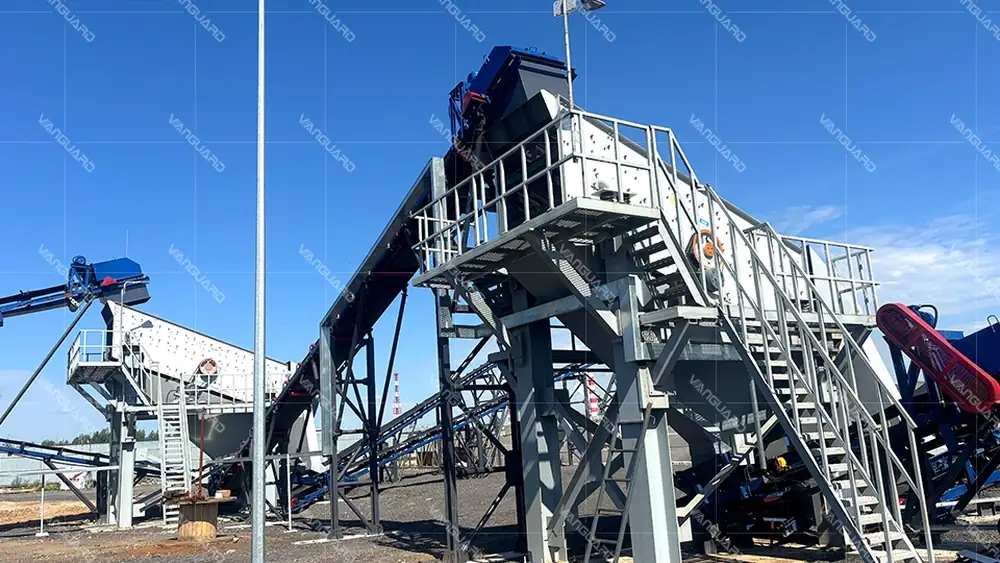
Vanguard Machinery's YA series circular vibrating screen uses a cylindrical eccentric-shaft vibrator and adjustable eccentric-block amplitude — reliable, strong excitation, high efficiency, low noise. It fits limestone, granite, basalt, iron ore, river pebble, construction waste and more across mining, building, energy and chemical industries.
| Model | Decks | Deck size (mm) | Capacity (m³/h) | Motor (kW) | Use |
| 2YA1548 | 2 | 1500×4800 | 22–160 | 15 | small line |
| 3YA1848 | 3 | 1800×4800 | 32–276 | 18.5 | mid line |
| 3YA1860 | 3 | 1800×6000 | 65–586 | 22 | mid-large line |
| 3YA2160 | 3 | 2100×6000 | 81–720 | 30 | large line |
| 3YA2460 | 3 | 2400×6000 | 90–810 | 37 | large line |
| 3YK3072 | 3 | 3000×7200 | 180–1300 | 30×2 | extra-large line |
Note: capacity depends on site config and material; confirm exact figures with Vanguard Machinery engineers.
6. Common sizing mistakes
- Mistake 1 "oversize the screen": bigger is better? Too big wastes capital and running cost, and a too-thin bed actually lowers efficiency. Size the area from real tonnage and material. - Mistake 2: ignore moisture and clay. High water blinds the deck and drops efficiency fast. Analyze material before selecting; add spray wash if needed. - Mistake 3: aperture = product size. Real aperture is usually larger than the cut (circular ~1.2×, fine up to 2×+). Picking the hole by product size is inefficient. - Mistake 4: ignore matching the upstream crusher. Vanguard Machinery advises screen capacity should exceed the crusher by 10%–20%; otherwise material piles into a "bottleneck."
7. Three questions to lock the screen
Guide signature — three questions: 1. How many grades, what tonnage? Grade count sets deck number (see §2 table); tonnage sets deck area, with 10%–20% margin over the upstream crusher. 2. What is the material's temper? Moisture >8%, clay >5% → wet screening / punched plate; flaky → round holes or high-frequency; heavy / abrasive → reinforced frame and polyurethane media. 3. Fixed or mobile, how high is the site? Tight plant → horizontal screen; open pit → inclined circular; fixed line → seated; mobile plant → on-board. Send the duty to Vanguard Machinery for a process calculation.
8. Data to collect before selection
| No. | Item | Note |
| 1 | Production needs | capacity target, grades, material type |
| 2 | Material traits | moisture, clay, size distribution, density, abrasion |
| 3 | Throughput & margin | t/h, annual hours, peak, expansion |
| 4 | Screening needs | per-grade ratio, aperture, efficiency, flakiness/powder limits |
| 5 | Site | fixed/mobile, power, space, height, dust/environment |
| 6 | Upstream | crusher model & setting, closed-circuit mode |
| 7 | Economy | capex, media cost, power, spares, maintenance (Vanguard Machinery can quote) |
9. FAQ
No. Too big wastes money and a thin bed lowers efficiency. Size the area from tonnage and material.
No. Circular hole ≈ 1.2× the cut; fine screening up to 2×+. Picking the hole by product size is inefficient.
Roughly: 1 grade single, 2 double, 3 triple, 4 four. But each deck cuts effective capacity 10%–15%; more is not always better.
Above 8% it blinds; use wet screening, punched plate + spray, or enlarge the deck and apply a reduction.
Screen capacity 10%–20% above the crusher, to avoid pile-up bottleneck on the deck.
Usually 2:1–3:1; length ~2.5–3× width. Width sets carrying, length sets precision.
Discharge bed ≤ 4× aperture; if over, widen the deck or raise the incline.
Fixed line: seated circular screen, easy service. Mobile plant: on-board screen for relocation.
10. Conclusion
Screen selection is a system task — capacity, deck area, deck number, aperture, material and installation together. Steps: define needs → analyze material → calculate area → pick model → verify parameters → consult the maker. Vanguard Machinery, a specialist in aggregate equipment, has deep experience designing crushing-screening lines; for line planning or screening support, contact the technical team for a duty-based custom solution.




