

1. Why Aggregate Shape Matters
Aggregate shape is one of the most critical factors determining the performance of concrete and asphalt mixtures. Cubical particles pack tightly within the mix matrix, maximizing inter-particle contact area and friction, which directly translates to higher compressive strength and improved structural stability. Conversely, flaky or elongated particles (those with a length-to-thickness ratio exceeding 3:1) create a bridging structure within the mix, increasing void content, raising cement demand, and reducing compressive strength.
Extensive field data shows that when flakiness content rises from 15% to 35%, the compressive strength of C30 concrete drops by approximately 12% to 18%, while cement consumption increases by 8% to 15%. In asphalt mixtures, excessive flaky particles lead to compaction difficulties, increased rutting depth, and reduced resistance to moisture damage. Selecting crushing equipment capable of producing superior aggregate shape is therefore the first and most important step in quality control.
2. Key Metrics for Evaluating Aggregate Shape
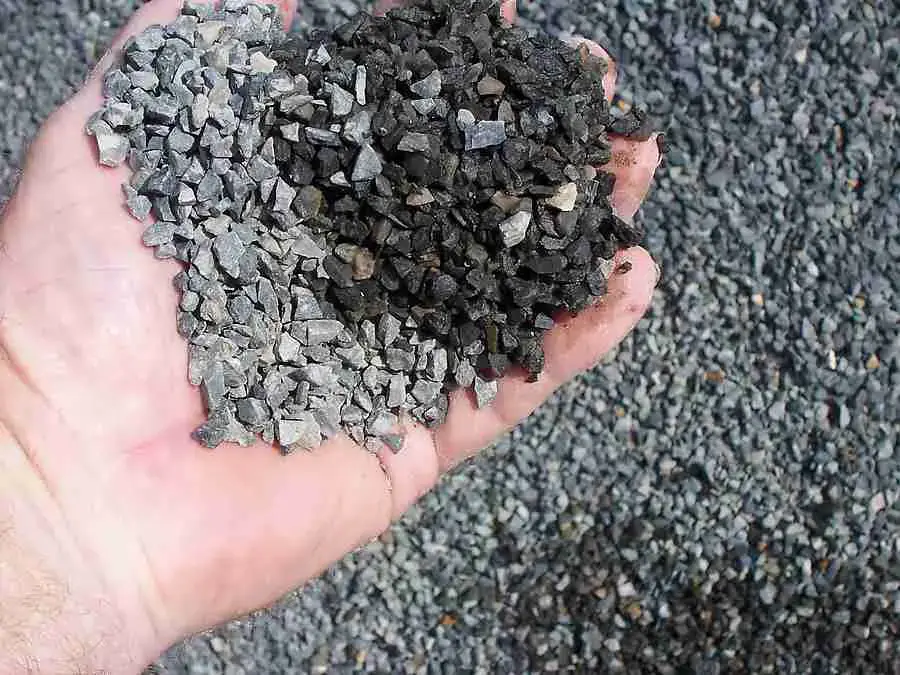
The industry uses several established metrics to quantify aggregate shape quality:
| Metric | Definition | Good Range | Impact on Concrete |
| Flakiness Index | Percentage of particles with length-to-thickness ratio > 3:1 | < 10> | Lower means stronger |
| Angularity Index | Composite score of corner count and roundness | 1.0 - 1.5 | Moderate is optimal |
| Elongation Ratio | Ratio of maximum to minimum particle dimension | < 2> | Lower means better workability |
| Surface Texture | Roughness of particle surface | Rough is preferred | Rougher means stronger bond |
| Cubical Ratio | Mass percentage of near-cubical particles | > 85% | Higher is better |
Among these five metrics, flakiness index is the most widely used quality control parameter, and every major standard sets explicit limits. The Chinese standard GB/T 14685 requires Class I aggregate to have flakiness content below 5%, Class II below 10%, and Class III below 15%.
3. How Different Crushing Principles Affect Shape
The final shape of an aggregate particle depends on the mechanical forces it experiences inside the crushing chamber. The four mainstream crushing principles produce fundamentally different shape outcomes.
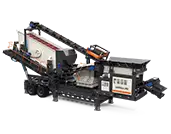
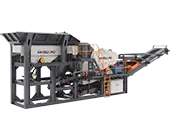
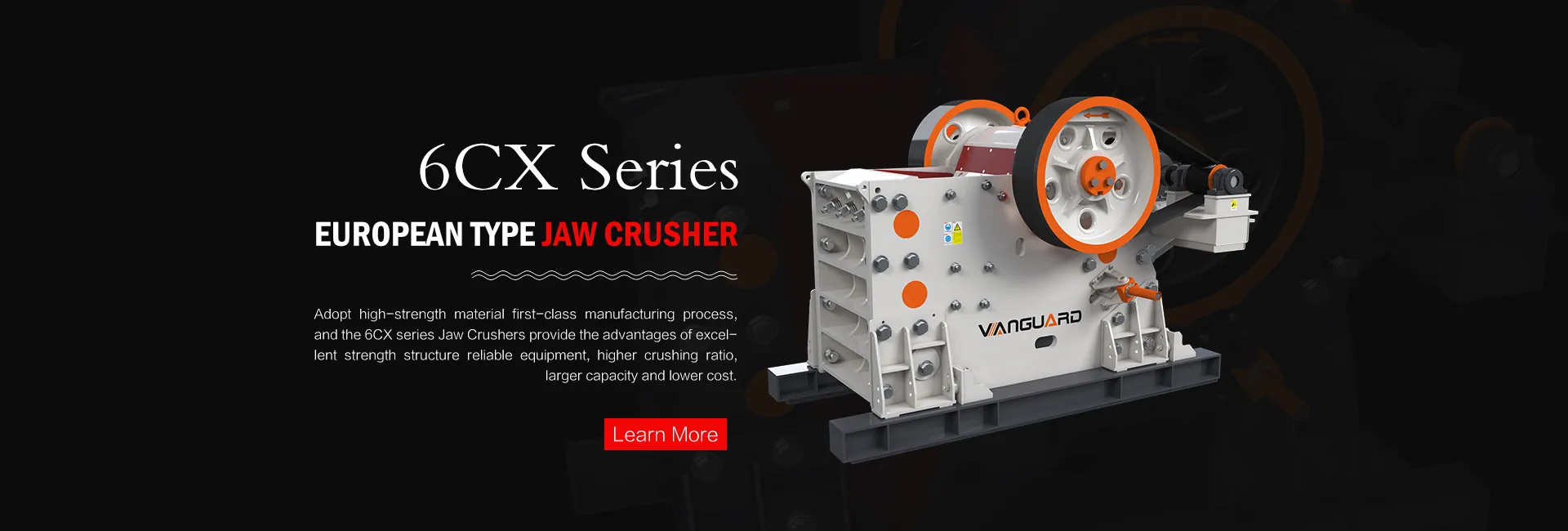
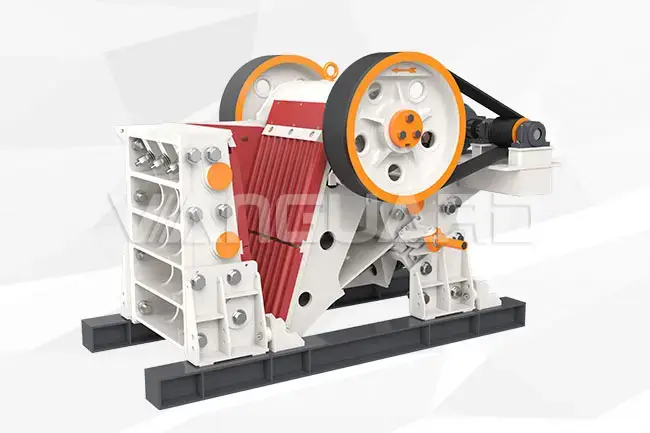
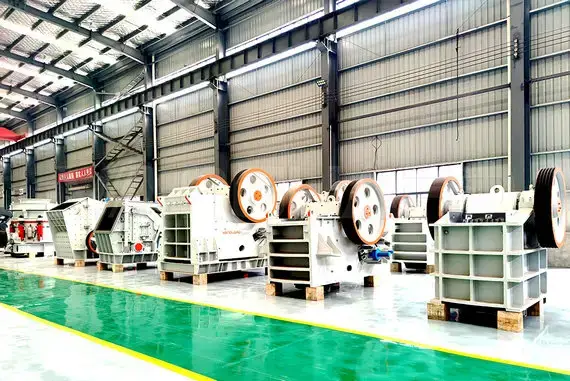
(1) Compression Crushing (Jaw Crushers and Cone Crushers)Compression crushing applies pressure between a moving jaw and a fixed jaw (or between a mantle and a concave), causing the material to fracture along its cleavage planes. The inherent weakness of this method is that fractures tend to follow cleavage planes, producing slabby or flaky particles. Jaw crushers (such as the 6CX Series and PE Series) feature a V-shaped chamber where material experiences short residence time and unidirectional compression. The resulting aggregate typically has a flakiness index of 25% to 40%. Cone crushers (such as the CP Series multi-cylinder hydraulic cone crusher and the CS/CH Series single-cylinder hydraulic cone crusher) improve on this through inter-particle layer compression, which can bring flakiness down to 15% to 25%, but this still falls short of premium aggregate requirements.
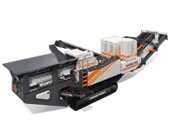
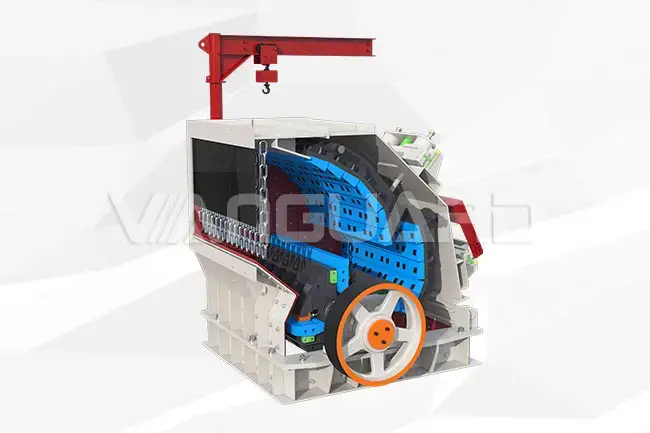
(2) Impact Crushing (Impact Crushers)Impact crushers (such as the 6FX Series, LF Series, and CI6X Series) use high-speed rotating blow bars to propel material against impact plates. The material undergoes repeated impacts between blow bars and impact plates, fracturing along multiple directions. This multi-directional stress pattern produces particles that are significantly more equidimensional (cubical), with flakiness index reduced to 10% to 18%. A further advantage of impact crushing is that particle surfaces are rougher, providing a stronger bond with cement paste.
 (3) Rock-on-Rock Impact Crushing (VSI Crushers / Sand Makers)
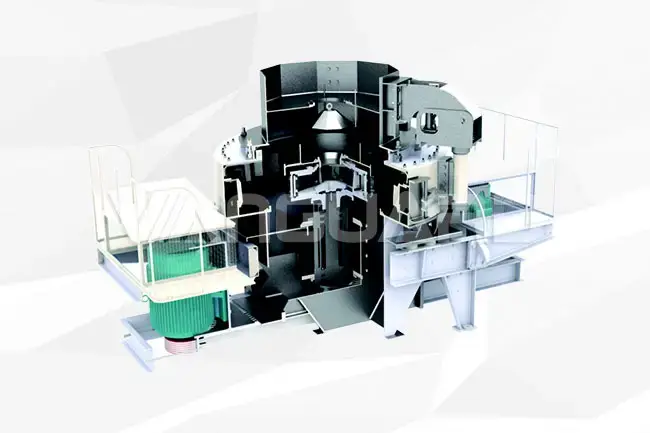
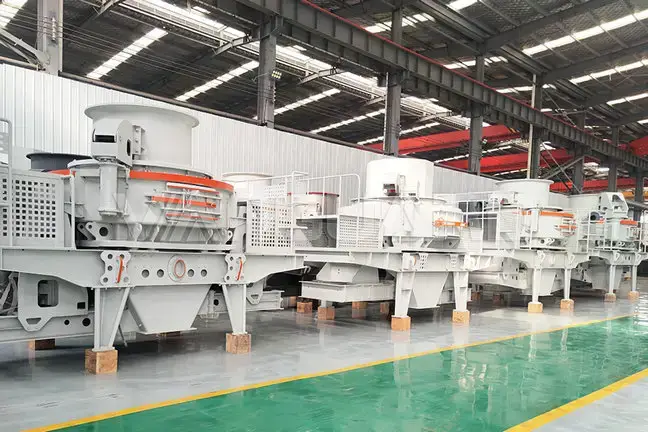
The 5X Series and VSI Series vertical-shaft impact crushers employ the rock-on-rock principle: material is accelerated by a high-speed rotor and launched against a material lining formed inside the crushing chamber. Particles collide with each other at high velocity, causing them to fracture along their weakest points in random directions. This method produces nearly fully equidimensional particles, with flakiness index below 5% and cubical ratio exceeding 90%. The rock-on-rock mode not only delivers the best particle shape but also minimizes metal wear, since crushing occurs primarily between particles rather than between particle and metal.
4. Head-to-Head Comparison of Four Crusher Types
The following table summarizes the key shape-related performance data across the four mainstream crusher types:
| Crusher Type | Representative Product | Crushing Principle | Flakiness Index | Cubical Ratio | Wear Cost per Tonne | Best Application Stage |
| Jaw Crusher | 6CX / PE Series | Compression | 25%-40% | 50%-65% | Low | Primary crushing |
| Cone Crusher | CP / CS Series | Layer compression | 15%-25% | 65%-78% | Medium | Secondary / tertiary |
| Impact Crusher | 6FX / CI6X Series | Impact | 10%-18% | 78%-88% | Medium-high | Secondary / shaping |
| VSI Crusher | 5X / VSI Series | Rock-on-rock impact | < 5> | > 90% | Very low | Tertiary shaping / sand making |
The table makes one conclusion unmistakably clear: the vertical-shaft impact crusher leads by a wide margin on both flakiness index and cubical ratio, making it the top choice for producing the best aggregate shape. Impact crushers follow closely, delivering significantly better shape than cone crushers in the secondary crushing stage. Jaw and cone crushers, as compression-type machines, lag in shape performance, but their stability and low wear costs when processing hard rock give them an irreplaceable role in the overall crushing circuit.
5. Multi-Stage Crushing Strategy: Balancing Throughput, Shape, and Cost
In a real production line, no single crusher can simultaneously meet all targets for throughput, shape, and cost. Vanguard Machinery recommends a multi-stage strategy where each stage has a clear mission:
| Material Type | Primary Stage | Secondary Stage | Tertiary Shaping Stage | Expected Flakiness Index |
| Limestone (soft) | 6CX jaw crusher | 6FX impact crusher | 5X VSI crusher | < 5> |
| Granite (hard) | 6CX jaw crusher | CP cone crusher | 5X VSI crusher | < 8> |
| Basalt (very hard) | 6CX jaw crusher | CS single-cylinder cone | 5X VSI crusher | < 8> |
| River gravel (medium-hard) | PE jaw crusher | CI6X impact crusher | VSI crusher | < 5> |
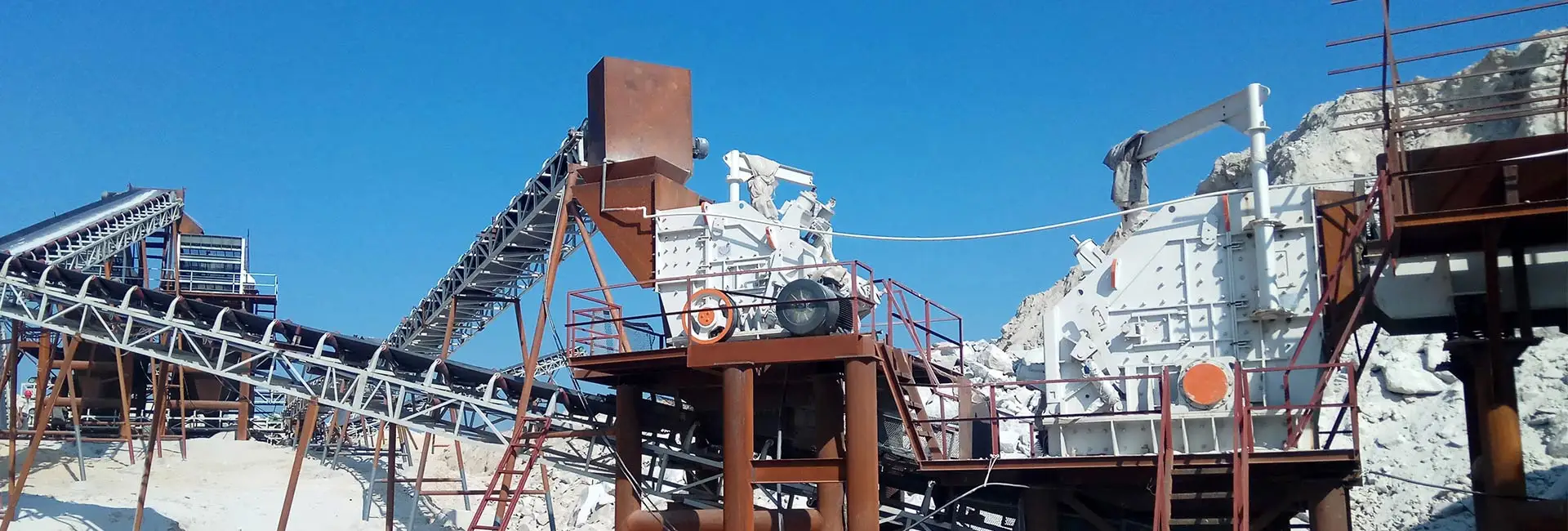
The core logic behind this configuration is straightforward: deploy jaw and cone crushers for the high-reduction primary and secondary stages, leveraging their throughput capacity and low wear cost; then use a 5X or VSI vertical-shaft impact crusher in the tertiary shaping stage, where the rock-on-rock principle optimizes particle shape to the highest possible standard. For soft rock, the secondary stage can use an impact crusher directly to achieve good shape in one pass. For hard rock, a cone crusher in the secondary stage controls wear cost, and the VSI crusher finishes the shaping job.
6. Vanguard Machinery Shape-Optimized Equipment
(1) 6FX Series Hydraulic Impact CrusherThe 6FX Series is Vanguard Machinery's next-generation hydraulic impact crusher, featuring a three-cavity impact plate design with blow bar tip speeds of 35 to 45 m/s. In limestone secondary crushing operations, the 6FX Series consistently delivers flakiness index values of 10% to 12% and cubical ratio above 85%. The hydraulic opening system allows blow bar and impact plate replacement in just 30 minutes, minimizing downtime.
(2) 5X Series Vertical-Shaft Impact CrusherThe 5X Series is Vanguard Machinery's flagship shaping and sand-making machine, featuring dual-mode switching between rock-on-rock and rock-on-steel. In rock-on-rock mode, material forms a self-lining layer inside the chamber, reducing metal wear to near zero. The resulting aggregate has a flakiness index below 5% and a cubical ratio exceeding 92%. The 5X Series rotor is manufactured from wear-resistant alloy with a design service life of 800 to 1,200 hours in rock-on-rock mode, performing particularly well in basalt shaping applications.
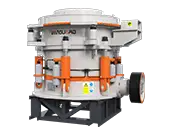
(3) CP Series Multi-Cylinder Hydraulic Cone CrusherThe CP Series balances throughput and shape in hard-rock secondary crushing. The layer compression principle causes particles to crush against one another, producing better shape than single-particle compression. A constant discharge opening control system ensures uniform secondary product gradation, providing stable feed for the downstream shaping stage.
7. Frequently Asked Questions
 Q1: Both impact crushers and VSI crushers produce good shape. Which one should I choose?
If your feed size is 100 to 300 mm and you need high throughput, choose an impact crusher (6FX Series or CI6X Series). If your feed is already below 40 mm and you need fine shaping or sand making, choose a VSI crusher (5X Series or VSI Series). The best results come from using both together: the impact crusher handles secondary crushing and preliminary shaping, while the VSI crusher performs final shaping.
Q2: Jaw crushers produce poor shape. Can I skip primary crushing and go straight to an impact crusher?
This is not recommended. The jaw crusher's primary crushing role is irreplaceable — it reduces raw material of up to 750 mm to below 150 mm in a single pass, providing acceptable feed size for downstream equipment. Feeding large blocks directly into an impact crusher would cause blow bar consumption to skyrocket and throughput to plummet. The correct approach is to use a jaw crusher for primary crushing, followed by an impact crusher for secondary crushing, where shape improves dramatically.
Q3: Can a cone crusher produce the same shape quality as an impact crusher?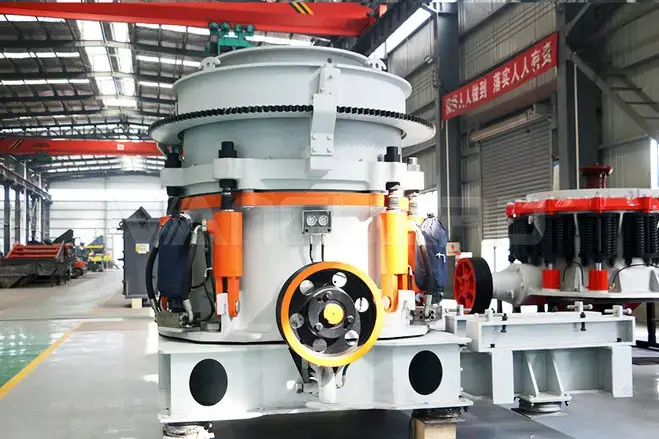
Under identical feed conditions, a cone crusher typically produces aggregate with a flakiness index 5 to 10 percentage points higher than an impact crusher. The cone crusher's advantage lies in its extremely low wear cost when processing hard rock. If a project demands premium shape, we recommend adding a 5X Series VSI crusher after the cone crusher for final shaping — this combination balances cost and shape.
Q4: Is there a significant shape difference between rock-on-rock and rock-on-steel modes on the 5X Series?Yes, the difference is notable. In rock-on-rock mode, particles collide against the self-formed material lining, with forces acting in multiple directions, producing the best shape (flakiness index below 5%). In rock-on-steel mode, particles strike metal impact plates, which increases crushing efficiency but slightly degrades shape (flakiness index around 8% to 12%). Vanguard Machinery recommends rock-on-rock mode for shape-critical projects and rock-on-steel mode for throughput-critical projects. The two modes can be switched at any time.
- Prev: No more
- Next:What Is the Best Cone Crusher for Quarry Projects in the Philippines?




