

Quick Answer
Granite ranks 6-7 on the Mohs scale with compressive strength up to 300 MPa, making it an extremely hard rock. The optimal crushing solution is: jaw crusher for primary crushing, cone crusher for secondary and fine crushing, and 5X/VSI impact crusher for sand shaping. The typical process flow is: ZSW vibrating feeder → 6CX/PE series jaw crusher (primary) → CP/CS-CH series cone crusher (secondary/fine) → 5X/VSI series impact crusher (sand shaping) → vibrating screening → XSD sand washer → finished aggregate. Mobile solutions such as the VPE tire-type mobile jaw crusher or C96/C106/C116 crawler mobile jaw crusher can reduce transportation costs by 30-40%. This guide covers equipment selection for 50-500 t/h capacities, cost comparisons and frequently asked questions.
Key Takeaways
- ✔ Jaw crushers (6CX/PE series) are the top choice for granite primary crushing, with feed sizes up to 1200 mm - ✔ Cone crushers (CP/CS-CH series) outperform impact crushers in granite secondary/fine crushing, with wear parts lasting 2-3 times longer - ✔ 5X/VSI series impact crushers produce the best-shaped granite sand, approaching a cubic form - ✔ Mobile crushing plants (VPE/VPC/C96-C106-C116) are ideal for scattered projects like road construction, saving 30-40% on transport costs - ✔ Complete process flow: feeding → jaw crushing → cone crushing → impact crushing → screening → washing → finished product
Why Granite Demands Special Consideration from Crushing Equipment
Granite is the most widely distributed intrusive rock in the Earth's crust, composed mainly of quartz, feldspar and mica. Its high hardness, high abrasiveness and dense structure require careful equipment selection. Choosing the wrong machine leads either to accelerated wear part consumption or failure to meet finished product specifications.
The following three properties determine the difficulty of granite crushing:
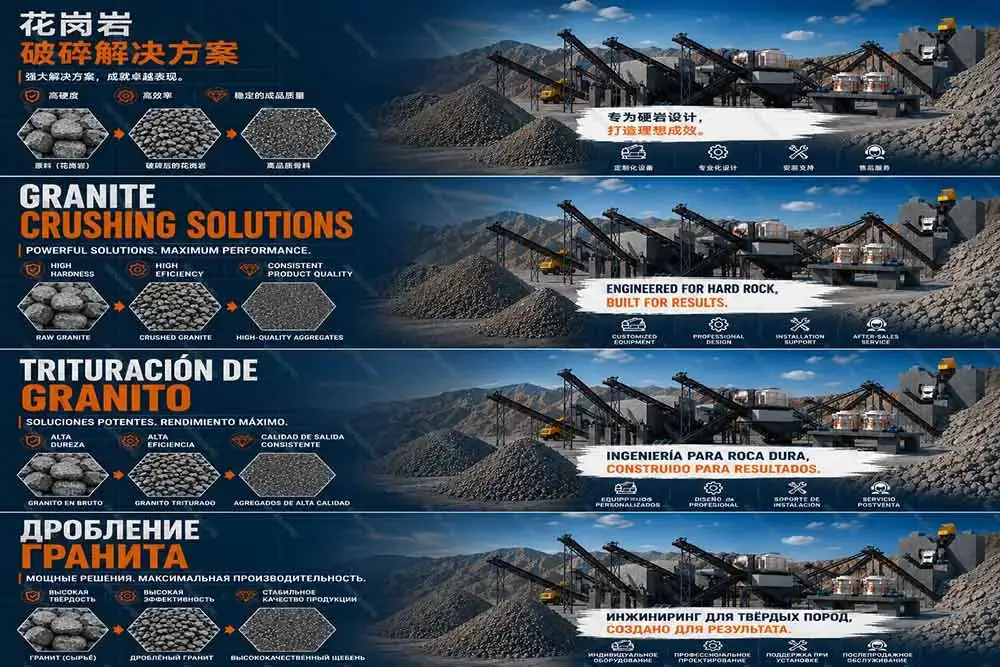
High Hardness and Abrasiveness: Granite rates 6-7 on the Mohs scale. Higher quartz content means more severe abrasion on crusher wear parts. Jaw crusher toggle plates and cone crusher mantle and concave wear 3-5 times faster than when crushing limestone.
High Compressive Strength: Granite compressive strength typically ranges from 120-300 MPa, far exceeding limestone (30-170 MPa) and sandstone (30-200 MPa). This means crushers must deliver greater crushing force.
Layered Structure Affects Particle Shape: Granite splits easily along cleavage planes. If the crushing method is inappropriate, the resulting aggregate will have a high flaky and elongated particle content, failing to meet highway and high-speed rail aggregate specifications.
| Parameter | Value Range | Impact on Crushing |
| Mohs hardness | 6-7 | Fast wear part consumption; select high-wear-resistant materials |
| Compressive strength | 120-300 MPa | Requires high crushing force; jaw and cone crushers preferred |
| Density | 2.6-2.8 t/m³ | Affects equipment capacity calculation |
| Quartz content | 20-60% | Higher quartz = stronger abrasiveness |
| Water absorption | 0.1-0.5% | Low absorption = good durability of finished aggregate |
| Flaky particle limit | ≤10% (highway/high-speed rail) | Impact shaping required to reduce flaky particles |
Jaw Crusher: The Top Choice for Granite Primary Crushing
Jaw crushers handle the first stage of granite crushing, reducing 500-1200 mm raw ore down to 100-250 mm.
Vanguard Machinery offers three series of jaw crushers:
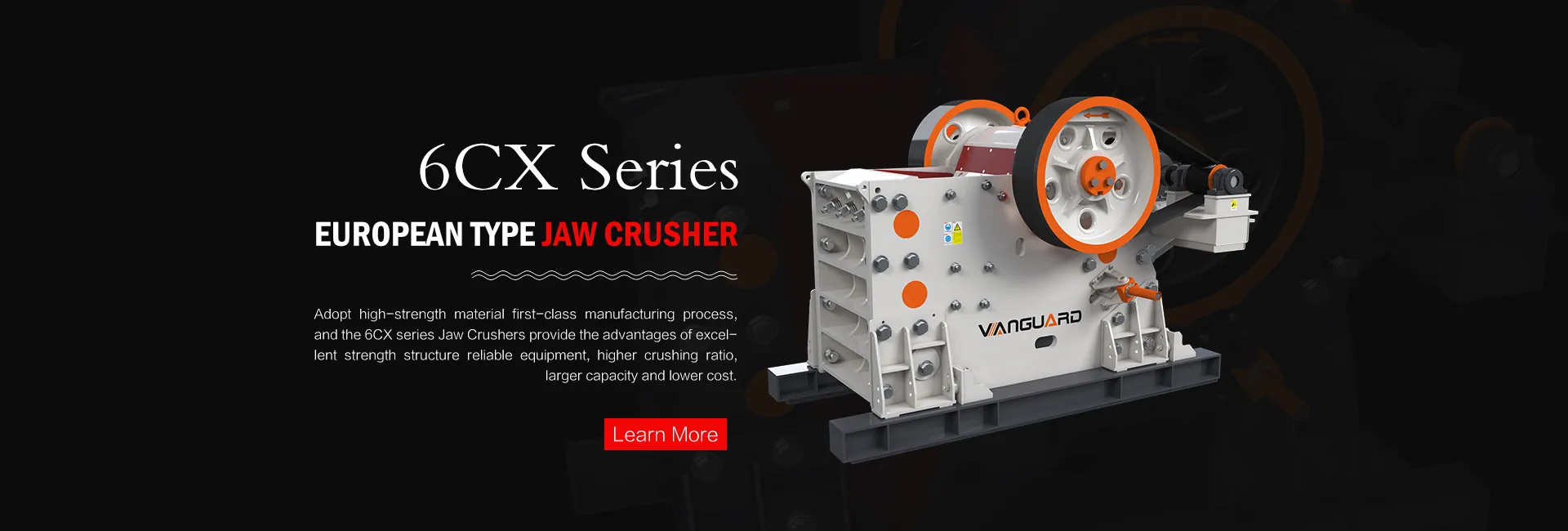
6CX Series: Next-generation high-efficiency jaw crusher featuring a deep crushing chamber design with large reduction ratio and high output. Suitable for large-scale granite quarries with feed sizes up to 1200 mm and single-unit capacity up to 800 t/h.
PE/PEX Series: Classic jaw crushers — PE for primary, PEX for secondary. Simple structure, easy maintenance, and the most economical choice for granite crushing lines.
PEW Series: European-style jaw crusher featuring a wedge discharge setting adjustment system for easier operation. Ideal for granite projects requiring tighter control over product size.
Selection advice: If feed size exceeds 600 mm, prioritize the 6CX series. If budget is limited and feed size is under 500 mm, the PE series offers the best value.
Cone Crusher: The Core of Granite Secondary and Fine Crushing
Cone crushers are the main workhorse for granite secondary and fine crushing, reducing 100-250 mm material from the jaw crusher down to 10-40 mm.
Why are cone crushers better suited than impact crushers for granite secondary/fine crushing?
Granite's high hardness and abrasiveness cause impact crusher blow bars and impact plates to wear extremely fast when processing granite, with replacement frequency 5-8 times higher than when crushing limestone. Cone crusher mantles and concaves made of high-manganese steel last 2-3 times longer while consuming less energy per unit of output.
Vanguard Machinery offers three series of cone crushers:
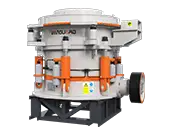
CP Series (Multi-cylinder Hydraulic Cone Crusher): High output, high automation, hydraulic discharge setting adjustment, and automatic iron-pass protection reset. Suited for medium-to-large granite lines with single-unit capacity up to 650 t/h.
CS/CH Series (Single-cylinder Hydraulic Cone Crusher): Compact structure, easy operation, laminated crushing principle delivers good particle shape. CS for secondary, CH for fine crushing.
CSV Series (Symons Cone Crusher): Traditional mechanical spring type with proven reliable structure and low maintenance cost. Ideal for budget-conscious projects.
| Parameter | CP Series | CS/CH Series | CSV Series |
| Type | Multi-cylinder hydraulic | Single-cylinder hydraulic | Spring |
| Max feed size | 300 mm | 230 mm | 300 mm |
| Capacity range | 80-650 t/h | 27-560 t/h | 25-560 t/h |
| Discharge adjustment | Full hydraulic automatic | Hydraulic | Manual |
| Iron-pass protection | Hydraulic auto-reset | Hydraulic | Spring |
| Application | Medium-large lines | Small-medium lines | Budget option |
Hammer Crusher: High Reduction Ratio Solution
The PCZ series heavy-duty hammer crusher offers unique advantages for granite crushing: one machine handles both primary and secondary crushing with reduction ratios up to 1:20, reducing equipment count and plant footprint.
However, note that hammer heads wear relatively fast when processing high-quartz granite. Use only when quartz content is below 30%. For high-quartz granite, stick with the classic jaw crusher + cone crusher combination.
Impact Crusher: The Best Choice for Granite Sand Making
Manufactured granite sand is essential for highways, high-speed rail and ready-mix concrete. The 5X and VSI series impact crushers use both "rock-on-rock" and "rock-on-iron" crushing modes, producing granite sand with near-cubic particle shape and well-graded distribution.
5X Series: Next-generation centrifugal impact crusher with modular rotor design that reduces wear part replacement cost by 30%. Deep-chamber rotor design increases throughput by 20%.
VSI Series: Classic impact crusher with proven stable structure. Optional hydraulic lid for convenient maintenance.
Selection advice: If the finished sand requires an MB value below 1.4 (high-speed rail standard), choose the 5X series. For limited budgets, the VSI series offers better value.
Mobile Crushing Plants for Granite Applications
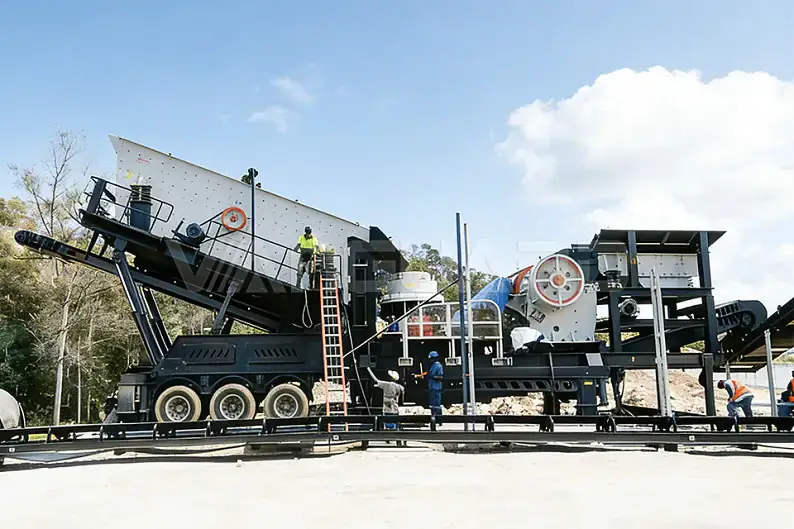
For scattered granite projects such as road construction and hydropower engineering, mobile crushing plants can significantly cut transportation costs by enabling on-site crushing and on-site use.
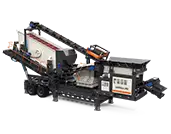
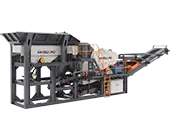
- VPE Series: Mobile jaw crushing plants for granite primary crushing. Models include VPE57, VPE69, VPE750, VPE96, VPE110, covering 50-300 t/h capacities. - VPC Series: Mobile cone crushing plants for granite secondary and fine crushing. - VPM-3 Series: Combined mobile crushing plants integrating feeder, crusher, and screening functions. Configurations include VPM-3 PCZ1310, VPM-3 PE57, VPM-3 PE69 and others.
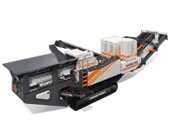
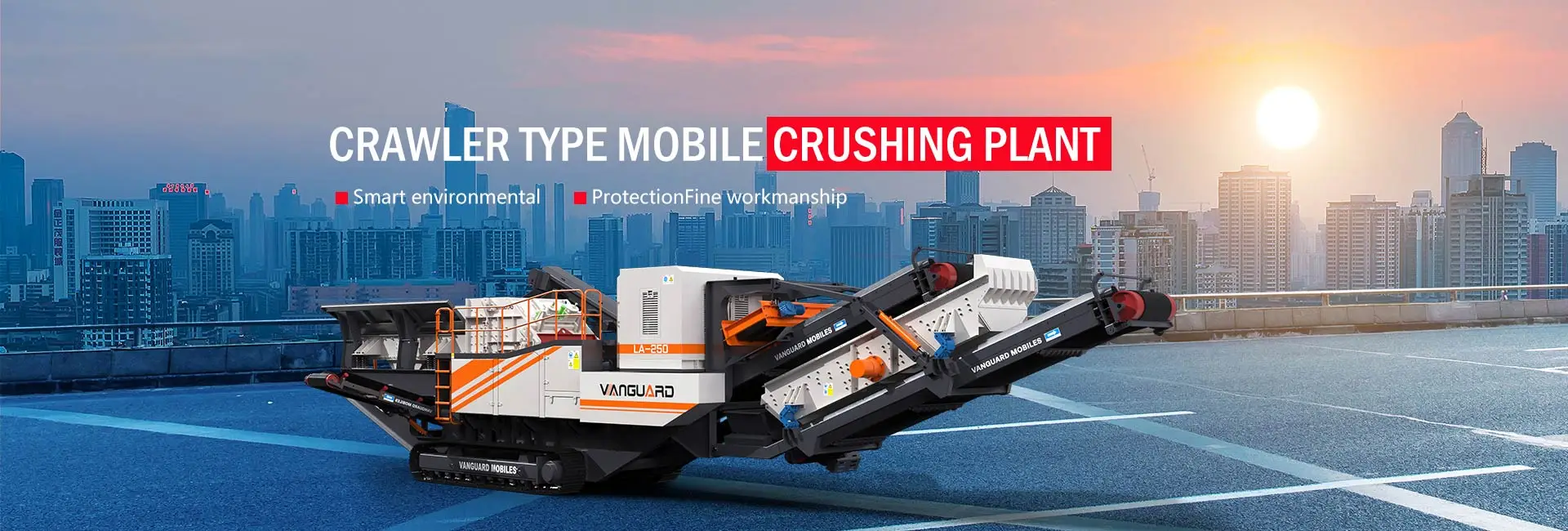
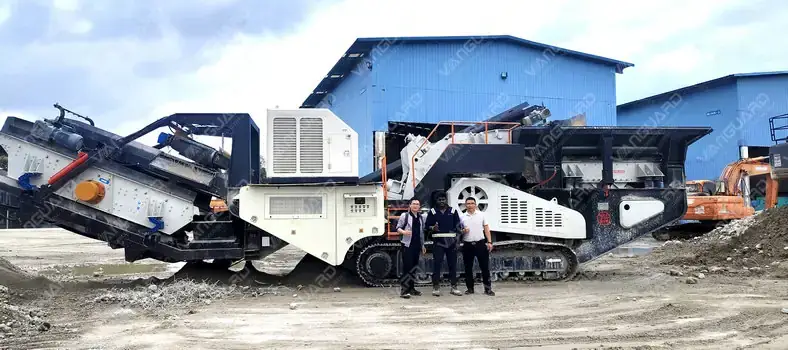
- C96/C106/C116: Crawler mobile jaw crushing plants with remote control operation, suited for mountainous and rugged terrain. - LA Series: Crawler mobile cone crushing plants for granite secondary and fine crushing.
| Factor | Tire-Type (VPE/VPC) | Crawler-Type (C96/C106/C116/LA) |
| Mobility | Trailer-towed, requires semi-truck | Self-propelled, remote controlled |
| Terrain suitability | Flat roads, urban roads | Mountainous, muddy, rough terrain |
| Equipment cost | Lower | Higher |
| Setup time | Ready immediately | Ready immediately |
| Typical application | Construction waste, road widening | Mining, hydropower, remote areas |
Complete Granite Crushing Process Flow
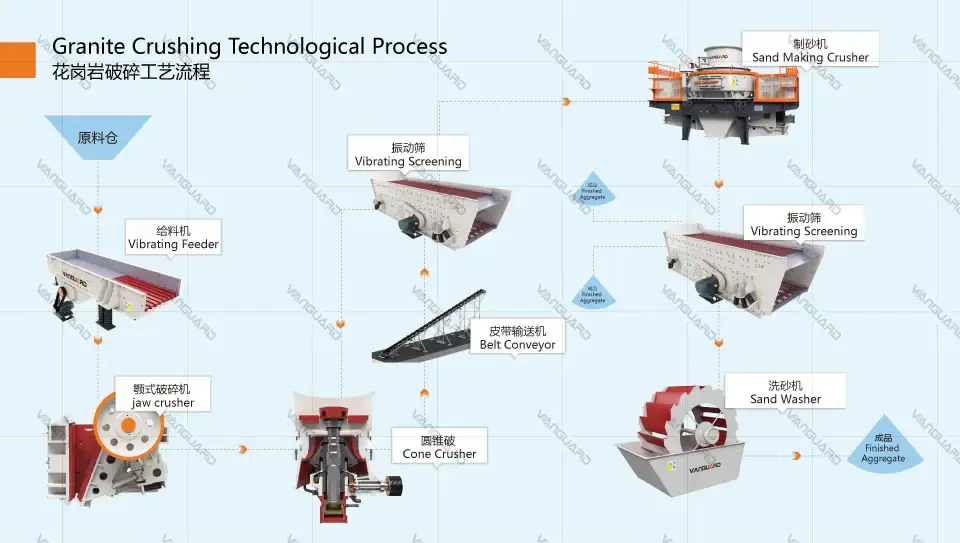
A complete granite production line includes the following stages:
Raw granite (500-1000 mm) → ZSW vibrating feeder → 6CX/PE jaw crusher (primary to 100-200 mm) → CP/CS cone crusher (secondary/fine to 20-40 mm) → 5X/VSI impact crusher (sand shaping to 0-5 mm) → Vibrating screening → XSD sand washer → Finished aggregate (0-5/5-10/10-20/20-40 mm)
- Set primary crusher discharge opening at 100-150 mm to ensure suitable feed size for the cone crusher - Use laminated crushing in the cone crusher with uniform feeding; a buffer hopper is recommended - Keep impact crusher feed size below 40 mm for optimal particle shape - Configure screening section with 4-layer screens to separate four products: 0-5/5-10/10-20/20-40 mm
Need help planning your granite crushing setup? Vanguard Machinery offers free material analysis and process design.
| Capacity (t/h) | Primary | Secondary/Fine | Sand Making | Screening |
| 50-80 | PE-57 jaw | CS cone | VSI impact | Vibrating screen |
| 80-150 | PE-69 jaw | CP cone | 5X impact | Vibrating screen |
| 150-250 | 6CX jaw | CP cone | 5X impact | Vibrating screen |
| 250-350 | 6CX jaw | CP cone (2 units) | 5X impact (2 units) | Screen (2 units) |
| 350-500 | 6CX jaw | CP cone (2 units) | 5X impact (2 units) | Screen (2 units) |
| Cost Item | Stationary Plant | Mobile Plant |
| Equipment investment | Lower (baseline 100%) | Higher (~120-140%) |
| Civil works | Concrete foundation required | No foundation needed |
| Installation time | 30-60 days | 1-3 days |
| Transportation cost | High raw material haul cost | On-site crushing saves 30-40% |
| Suitable project duration | Long-term fixed (5+ years) | Short-term scattered (1-3 years) |
| Annual operating cost | Baseline 100% | ~85-90% |
Vanguard Machinery Project Experience
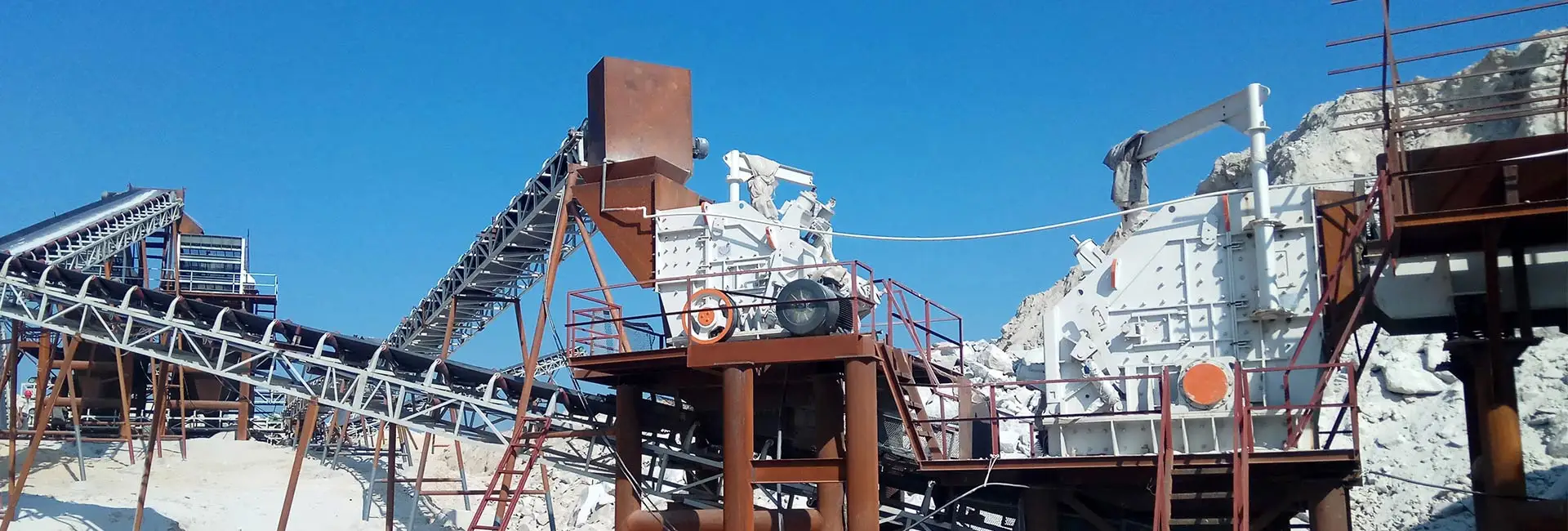
Vanguard Machinery has delivered multiple granite crushing production lines to customers across Southeast Asia, the Middle East, Africa and South America. In a Southeast Asian highway project, Vanguard Machinery supplied a stationary configuration of 6CX jaw crusher + CP cone crusher + 5X impact crusher, producing 2 million tons of granite aggregate per year with flaky particle content held below 8%, meeting expressway surface course standards. In an African granite quarry project, a combination of C96 crawler mobile jaw crusher + LA crawler mobile cone crusher achieved on-site crushing and direct sales, cutting transportation costs by 35%.
Frequently Asked Questions
Not recommended as the main secondary/fine crusher. Granite's high hardness and abrasiveness cause impact crusher blow bars to wear extremely fast, with replacement frequency 5-8 times higher than when processing limestone, leading to significantly increased downtime. Use cone crushers (CP/CS-CH series) for secondary and fine crushing instead. Impact crushers can be used for final sand shaping.
The comprehensive cost for a stationary plant processing granite is approximately 8-15 RMB/ton (including electricity, wear parts and labor), while mobile solutions run around 12-20 RMB/ton. Actual costs depend on capacity scale, local electricity prices and wear part consumption.
The 6CX series delivers higher capacity and larger reduction ratio, making it ideal for large quarries with feed sizes above 600 mm. The PE series has a simpler structure and lower price, suited for projects with feed sizes under 500 mm and limited budgets. If capacity exceeds 200 t/h, go with 6CX.
The 5X series is a next-generation impact crusher with modular rotor design that cuts wear part replacement cost by 30%. It is ideal for projects demanding premium sand particle shape (such as high-speed rail and expressways). The VSI series offers proven stable performance at a lower price point, suitable for ordinary ready-mix concrete applications.
Cone crushers are better suited for granite. Hammer crushers (PCZ series) offer large reduction ratios and fewer machines, but hammer heads wear quickly on high-quartz granite. If quartz content is below 30%, a PCZ hammer crusher can serve as a combined primary + secondary solution; above 30%, the jaw crusher + cone crusher combination is more economical.
Yes, for short-term or scattered projects. Their advantages include no foundation requirements and easy relocation, fitting 1-3 year cycle projects like road construction and hydropower. For long-term fixed quarries of 5+ years, stationary plants offer lower equipment investment and higher capacity.
If the finished sand is intended for highways or high-speed rail, water washing is needed to remove stone powder. XSD series sand washers can keep fines below 0.075 mm within specification limits. For ordinary construction concrete, follow local regulations.
A 200 t/h stationary granite line needs roughly 2000-3000 m² (including raw material stockpile, production area and finished product yard). A mobile setup requires less space, about 1000-1500 m².
When processing granite, high-manganese steel plates typically last 300-600 hours depending on quartz content. High-chromium composite plates can extend service life by 50-80%. Inspect plate wear regularly and replace once wear exceeds 50%.
0-5 mm manufactured sand goes into concrete and mortar; 5-10 mm crushed stone serves as concrete fine aggregate; 10-20 mm for concrete and pavement; 20-40 mm for subgrade and railway ballast. Granite aggregate is also used for high-speed rail ballastless tracks and airport runways.
Small lines (50-80 t/h): around 0.8-1.5 million RMB; medium lines (150-250 t/h): around 2-4 million RMB; large lines (350-500 t/h): around 5-10 million RMB. Investment covers equipment, civil works, electrical systems, dust control and installation/commissioning.
Yes. Granite crushing generates substantial dust, requiring pulse jet dust collectors or mist spray systems. All Vanguard Machinery crushing lines come standard with dust control equipment ensuring emissions comply with environmental standards.
Conclusion
The core principle of granite crushing is "hard rock, hard crush": jaw crushers (6CX/PE series) for primary crushing, cone crushers (CP/CS-CH series) for secondary and fine crushing, and impact crushers (5X/VSI series) for sand shaping. Avoid using impact crushers as main secondary/fine crushers, and avoid hammer crushers for high-quartz granite. Mobile solutions (VPE/VPC/C96-C106-C116) suit scattered projects. Base your selection on granite hardness, quartz content and finished product requirements, matched to capacity scale and budget.




